
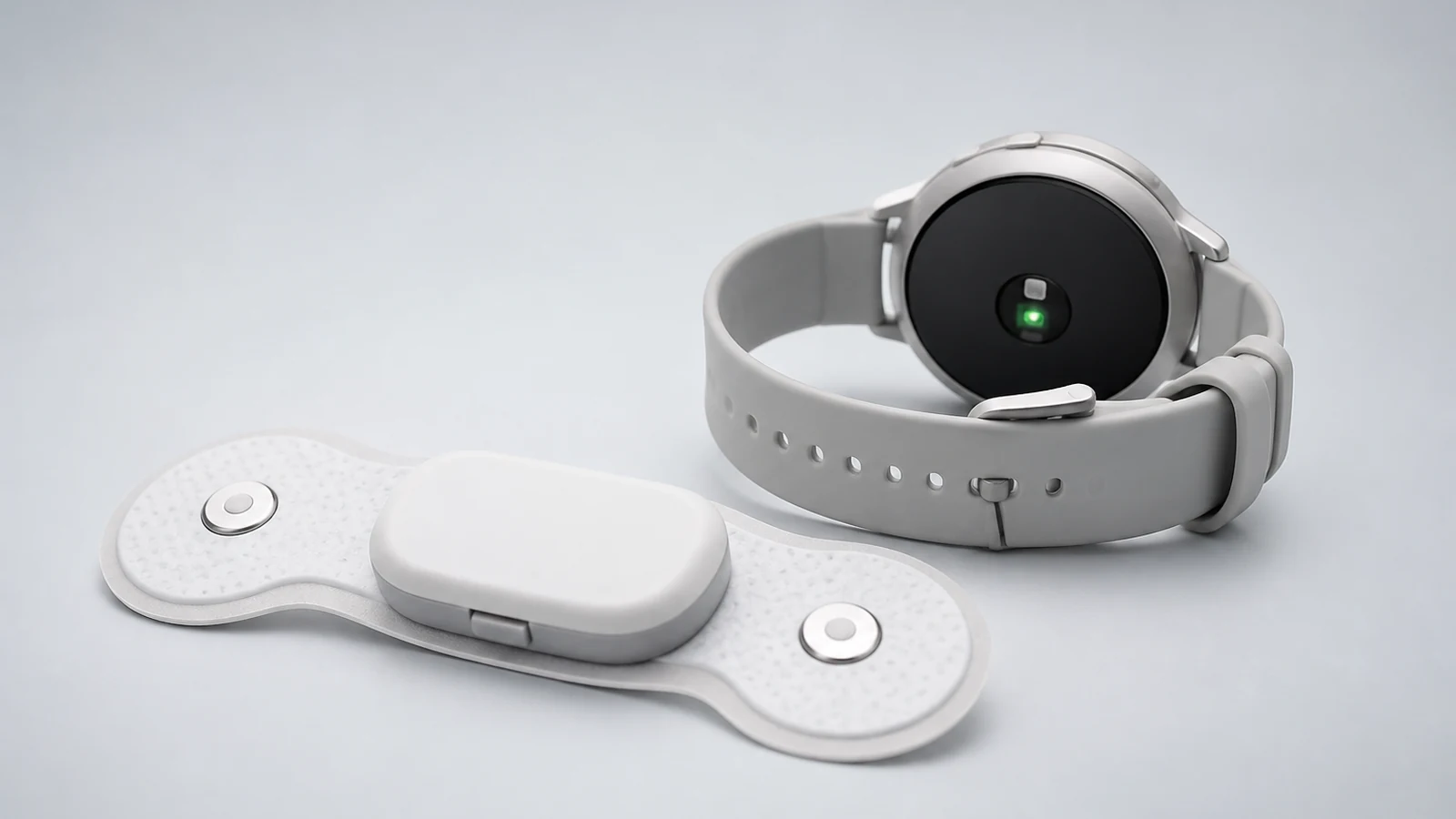
The driver monitoring conversation has mostly been about what's built into the vehicle — cameras in the dash, sensors in the steering wheel, electrodes in the seat. But there's a physiological sensing platform already sitting on millions of drivers' wrists every time they get behind the wheel, and it's not automotive hardware at all. It's a consumer smartwatch or fitness band, already measuring heart rate, heart rate variability, and motion, built by companies with no automotive ambitions whatsoever.
This post asks a genuinely open engineering question: could wrist- or ear-worn wearables meaningfully complement, or even substitute for, camera-based driver monitoring — and where does that idea hold up versus fall apart?
The Case for Wearables in the Driver's Seat
The core appeal is straightforward: a consumer wearable already carries much of the physiological sensing hardware that in-cabin systems have been trying to build from scratch — PPG for heart rate, IMU for motion, and increasingly, more advanced biosignal sensing, all in a form factor the driver brings with them rather than one the vehicle has to embed.
Automotive researchers have already prototyped exactly this. One system uses a PPG sensor on the driver's finger, connected to a wrist-worn wearable device, with a Bluetooth Low Energy module transmitting driver alertness data — evaluating alertness through a fusion of direct physiological measurement and indirect behavioral signals, rather than camera-based observation alone.
There's also a growing automotive industry interest that goes beyond monitoring into integration. Automakers have shipped smartwatch-linked features that go from simple convenience — remote ignition, personalized seat and climate settings triggered automatically when a specific driver's watch connects to the vehicle — to genuine biometric integration, with some manufacturers exploring direct health tracking built into the vehicle itself, such as accessing heart rate and respiration through the steering wheel or seat, alongside wearable-based approaches running in parallel.
- Why Full Replacement Is Unlikely — The Real Constraints
For all that promise, treating a wearable as a wholesale replacement for camera-based DMS runs into structural problems that are worth being honest about.
Compliance can't be assumed. A vehicle's in-cabin camera works whether or not the driver wants it to. A wearable-based system only works if the driver is actually wearing the device, has it charged, and has it paired — none of which a vehicle can guarantee or enforce the way it can with embedded hardware. Any safety-critical system built around an assumption the vehicle can't verify is a genuine reliability risk, not a minor inconvenience.
Regulatory frameworks are written around vehicle-embedded sensing. As covered in our post on the global DMS regulatory landscape, mandates like the EU's GSR specify a closed-loop, on-vehicle processing model for driver monitoring data. A third-party consumer wearable, with its own app, cloud sync, and data-handling practices designed for fitness tracking rather than automotive compliance, doesn't naturally fit that regulatory model — and retrofitting it to comply would mean the wearable manufacturer essentially building a parallel, automotive-grade data pipeline alongside their consumer one.
Signal fidelity wasn't designed for this use case. Consumer wearables are built and validated for general fitness and wellness use, not for split-second safety-critical alertness classification. The accuracy bar, latency requirements, and failure-mode tolerance for "warn a driver before a crash" are considerably stricter than "estimate resting heart rate for a fitness app" — the same gap in clinical validation rigor we covered in our post on FDA clearance for wearables.
Battery life and charging habits work against continuous availability. A dashboard camera is powered by the vehicle every time the car runs. A wearable depends on the driver having charged it recently enough, and wearing it consistently enough, to have usable data during the specific drive that matters — a dependency camera-based systems simply don't carry.
Where the Idea Genuinely Works: Complement, Not Replacement
The more realistic, and genuinely promising, framing isn't replacement — it's fusion. This tracks directly with the broader theme from our post on multimodal driver state sensing: no single sensing modality is reliable enough alone, and the right architecture treats each stream as one input among several rather than the sole source of truth.
Wearables add a physiological signal camera-based systems structurally can't get as easily. A camera infers alertness indirectly, from eye and facial behavior. A wearable measures heart rate variability directly — a genuinely different and complementary signal, not a redundant one, and one that isn't affected by the lighting and visibility conditions that degrade camera performance.
Optional, opt-in enhancement sidesteps the compliance problem. Rather than depending on a wearable for baseline safety compliance, a system can treat wearable data as a bonus input when available — improving detection confidence for drivers who choose to connect a device, without making the core safety system dependent on something the vehicle can't guarantee.
The personalization and convenience use case is already proven out. Automaker experiments connecting smartwatches for driver-specific vehicle personalization — seat position, climate, remote start — demonstrate a workable integration pattern that doesn't carry safety-critical stakes, and that pattern extends naturally to layering in supplementary wellness data once the connection already exists for convenience purposes.
Fleet and commercial contexts lower the compliance barrier. Unlike a personal vehicle where wearable use can't be mandated, commercial fleets can require drivers to wear a company-issued, purpose-built wearable as a condition of employment — closing the compliance gap that makes wearables unreliable in a consumer-vehicle context, and making fleet operations a genuinely strong near-term use case for wearable-based driver monitoring.
What This Means for Teams Designing Cross-Platform Driver Sensing
For hardware and firmware teams considering wearable integration as part of a driver monitoring strategy, a few principles keep the idea grounded in what's actually achievable:
Design wearable input as an enhancement layer, never a dependency. The core safety system needs to function fully without wearable data present — treating a connected wearable as bonus signal that improves confidence, not as required infrastructure.
Build the vehicle-side pipeline to be wearable-agnostic. Rather than integrating tightly with one manufacturer's ecosystem, a BLE-based, standards-friendly ingestion layer keeps the system usable across whatever wearable a given driver happens to already own.
Treat fleet and consumer contexts as genuinely different problems. A fleet-issued, purpose-built wearable with guaranteed compliance is a fundamentally different engineering and business problem than hoping a personal-vehicle driver happens to be wearing their own smartwatch that day.
Borrow validation rigor from wearable health-tech, not fitness-tech. If wearable data is going to inform any safety-relevant decision, the underlying PPG and motion sensing needs validation closer to the clinical-grade standards we've covered in our wearable health content, not the looser accuracy tolerances acceptable for a step counter.
Conclusion
A smartwatch isn't going to replace the camera on your dashboard — the compliance, regulatory, and validation gaps are real and shouldn't be waved away. But the more interesting question was never really about replacement. It's about whether the physiological sensing already living on millions of wrists can meaningfully sharpen the multimodal fusion architecture that's already the direction driver monitoring is heading — adding a genuinely independent signal to a system that gets more robust, not less, every time it has another reliable input to draw on.
At CoBuild Labs, this is exactly the kind of cross-domain sensing question our wearable and automotive work keeps intersecting on — where the same PPG/IMU fusion that powers cardiovascular wearables has bounded relevance behind the wheel — see also multimodal DMS.
Exploring cross-platform driver sensing? Talk to CoBuild Labs — see wearable prototyping, multimodal DMS, and fleet driver health.