
Ask which sensor best detects driver drowsiness, and the honest engineering answer is: none of them, reliably, on their own. Eye-tracking cameras lose accuracy in poor lighting. Physiological sensors depend on maintaining good contact. Even steering behavior can look identical between a drowsy driver on a straight highway and an alert one who simply isn't correcting much. Driver monitoring research has converged on a fairly consistent conclusion: robust detection requires fusing evidence from multiple, independent sensing streams — not perfecting any single one.
This post looks at the three main information streams used in modern driver state sensing, how they get fused together, and what that fusion actually costs an embedded system in compute and integration complexity.
The Three Streams
Driver monitoring research generally organizes sensing into three technical classes, each capturing a genuinely different signal about the driver.
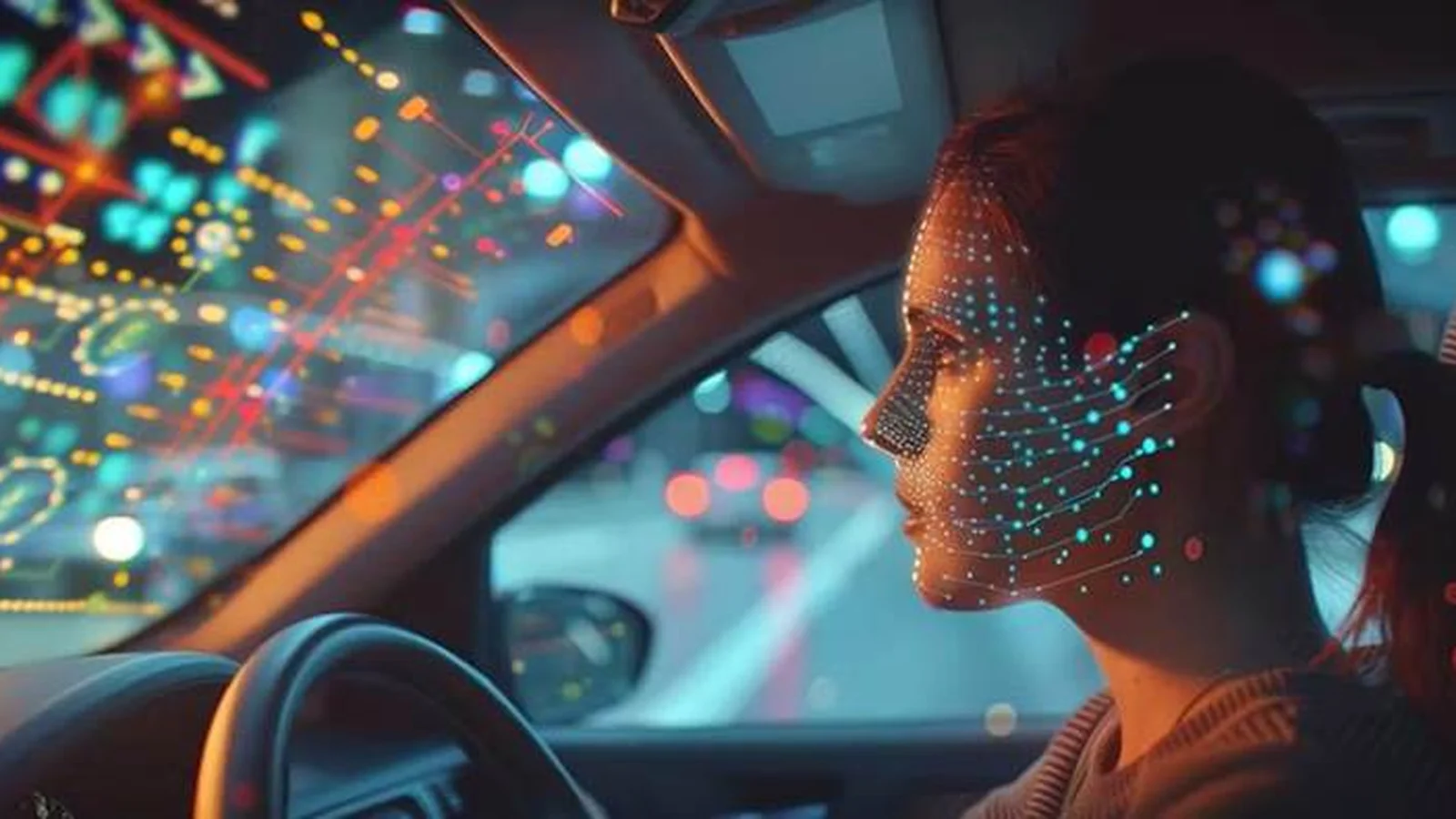
Facial and gaze-based sensing (vision). Camera-based systems track eye status, blink rate, and head position — with PERCLOS (the percentage of time the eyes are more than 80% closed) considered one of the most effective individual parameters for drowsiness detection. Deep learning approaches using facial landmark detection have demonstrated very high accuracy in non-intrusive, real-time settings, and this remains the most mature and widely deployed sensing modality in production vehicles today.
Physiological signals. Heart rate, heart rate variability, brain activity (EEG), and muscle activity (EMG) — captured through steering-wheel, seat, or wearable sensors, as covered in our recent post on physiological sensing entering the cabin — reflect the driver's internal state more directly than any external observation can, at the cost of harder signal acquisition.
Vehicle-kinematic signals. Steering angle variance, correction frequency, lane position variability, and time-to-line-crossing predictions capture how the driver is actually controlling the vehicle. This category has a genuinely elegant engineering property: it requires no additional sensor hardware at all — the data already exists in the vehicle's steering and stability systems — making it essentially free to add compared with a camera or physiological sensor. One study even showed that lateral lane position variability can be mathematically derived from steering wheel angle changes through a transfer function, providing a cost-effective proxy for lane tracking that keeps working when video-based lane detection fails due to missing lane markers, bad weather, or darkness.
Why Fusion Outperforms Any Single Stream
The case for fusion isn't just theoretical — it shows up directly in comparative studies. Research combining steering behavior with camera-based eye tracking found that fusing the two data streams reduced uncertainty in the drowsiness inference and produced better system performance than either sensor alone, using a formal evidence-combination framework (Dempster-Shafer theory) to weigh and merge the two inputs. In a more applied context, integrating steering-pattern analysis with lane departure warning systems has been shown to improve detection accuracy by roughly 18-22% through sensor fusion compared to steering data alone.
Each stream also compensates for the others' specific blind spots:
- Vision fails under environmental stress — poor lighting, glare, obstruction — where vehicle-kinematic signals keep working regardless of visibility conditions.
- Vehicle-kinematic signals are context-dependent — steering entropy analysis is highly effective on highway driving with minimal turns, but far less reliable in urban environments full of frequent, intentional steering inputs that look similar to drowsy over-corrections.
- Physiological sensing depends on contact quality — which vision and vehicle-kinematic data don't require at all, making them useful fallbacks when a steering-wheel ECG signal drops out.
The practical implication: a system relying on any single modality has a predictable set of conditions under which it degrades. Fusion doesn't eliminate those weak points — it ensures that when one stream degrades, the others are still contributing useful, independent evidence.
What Fusion Actually Costs an Embedded System
This robustness isn't free. Multimodal fusion raises real compute and integration burden that has to be engineered for deliberately, not treated as a downstream software problem.
Different data streams need different pipelines. Camera data typically flows through a computer vision pipeline (increasingly involving deep CNNs or transformer-based architectures for facial landmark analysis), while physiological signals need dedicated analog front-end processing and biosignal-specific filtering, and vehicle-kinematic data comes from CAN bus signals already present in the vehicle's electronic architecture. A fusion system has to synchronize and align three fundamentally different data types running at different sampling rates, not simply concatenate their outputs.
Individual calibration matters more than in single-modality systems. Steering-based detection specifically requires baseline calibration during alert driving periods to establish each individual driver's normal pattern — a personalization step that adds complexity but is necessary because steering behavior varies enormously between drivers even at the same alertness level.
Temporal modeling adds another compute layer. Because drowsiness and fatigue build up gradually, effective systems increasingly rely on attention mechanisms or recurrent architectures (RNN/LSTM) to capture long-term patterns across a driving session, rather than just classifying instantaneous state from a single frame or sample window — a meaningfully heavier compute requirement than frame-by-frame classification.
Fusion architecture is itself a design decision, not an afterthought. Different studies use different fusion strategies — some combining raw or feature-level data before classification, others using formal evidence-combination frameworks like Dempster-Shafer theory to merge independent classifier outputs — and the choice affects both accuracy and how gracefully the system degrades when one input stream drops out.
Engineering Implications for a Production DMS Platform
For teams designing a multimodal driver monitoring system meant to actually ship, a few decisions are worth making deliberately:
Treat vehicle-kinematic sensing as the free, always-available baseline. Since it requires no new hardware, it's the natural fallback stream to lean on when camera or physiological signals degrade — architecting the fusion logic to gracefully weight toward whichever stream is currently most reliable, rather than requiring all three simultaneously.
Budget compute for synchronization, not just individual-stream inference. The real integration cost of multimodal fusion is aligning heterogeneous data streams and running a fusion or temporal model on top of them — this needs to be sized into the embedded compute budget from the architecture stage, not discovered once individual sensor pipelines are already built.
Plan for per-driver calibration as a product requirement, particularly for vehicle-kinematic sensing, since it directly affects accuracy and needs a defined onboarding or baseline-establishment flow.
Choose a fusion strategy that degrades gracefully. A system that fails outright when one stream drops out defeats the purpose of fusion; the architecture should be able to fall back toward the remaining reliable streams rather than requiring complete sensor availability.
Conclusion
The move toward multimodal driver state sensing reflects a broader lesson that shows up across sensing-heavy engineering domains: any single sensor has predictable conditions under which it fails, and the fix isn't a better sensor — it's an architecture that doesn't depend on any one sensor working perfectly all the time. Vision, physiology, and vehicle behavior each carry genuinely independent information about driver state, and the compute cost of fusing them well is the price of a system that degrades gracefully instead of failing silently exactly when it matters most.
At CoBuild Labs, this is the same systems-engineering discipline we bring to multimodal wearable sensing — treating sensor fusion as core architecture — whether wrist, ear, or steering wheel — with AI integration and cabin physiological sensing.
Designing a production DMS sensor stack? Talk to CoBuild Labs — related reading: smart driver monitoring, the DMS trust problem, and cabin physiological sensing.