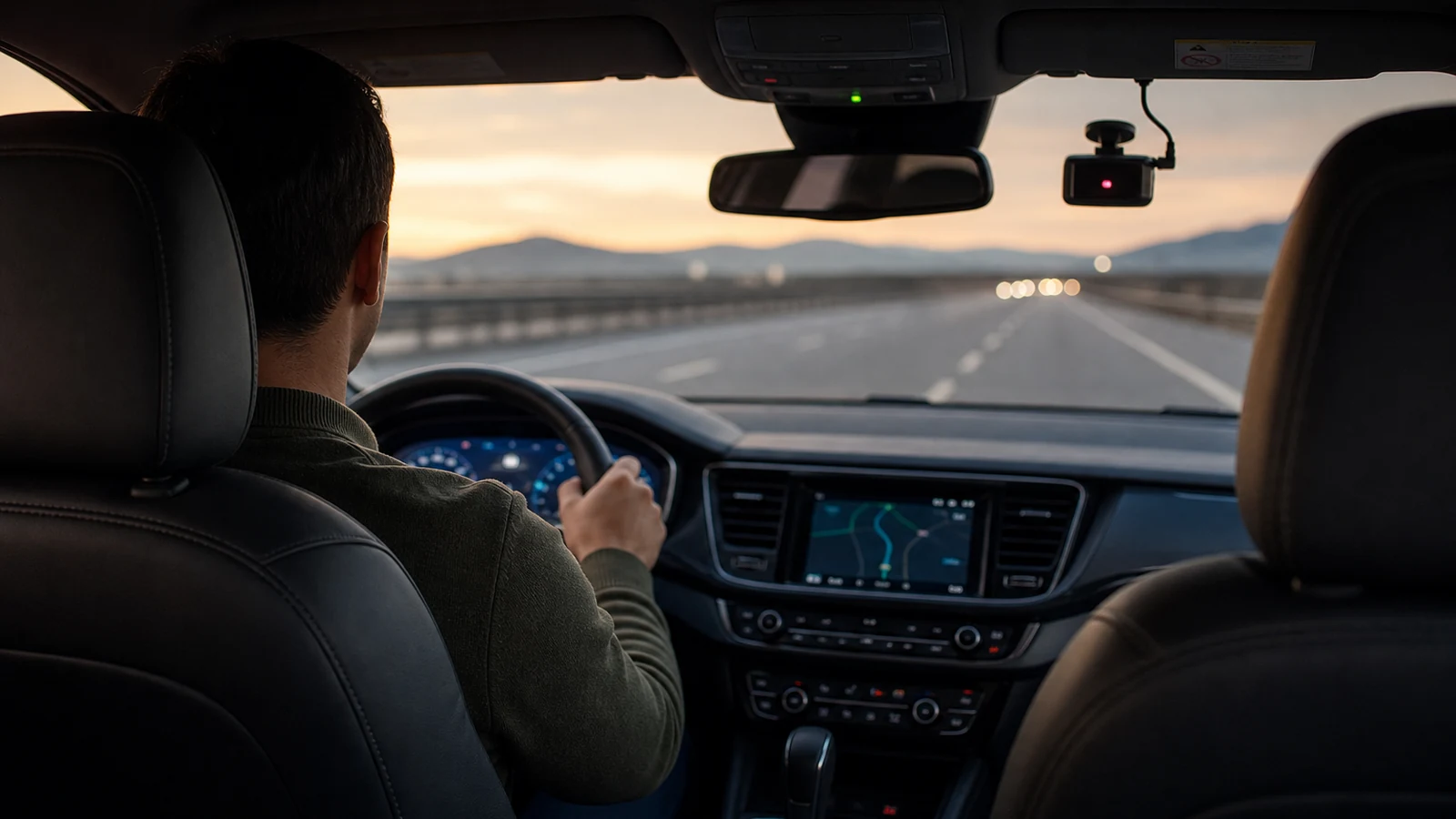
Drowsy driving doesn't announce itself the way speeding or a missed stop sign does. There's no single moment a fleet safety manager can point to and say "that's when it happened" — fatigue builds quietly, and by the time it shows up in a crash report, the cost has already been paid in medical claims, vehicle damage, litigation exposure, and insurance premiums that climb for years afterward. For commercial fleets, driver health monitoring has moved well past a regulatory checkbox. It's become one of the more measurable return-on-investment stories in fleet operations.
This post looks at what the actual numbers show, why fatigue detection is harder to get right than other safety behaviors, and what that means for fleets evaluating whether to invest.
Why Fatigue Is a Distinct, Harder Problem
Unlike mobile phone usage or speeding — clear, objective behaviors a system can flag with high confidence — drowsiness isn't a single observable action. It shows up as a cluster of individually ambiguous signals: head nodding, slouching, prolonged eye closure, yawning, rubbing eyes, and other cues, none of which is a sufficient detector on its own. One large-scale analysis found that roughly 77% of actual drowsy driving events were caught by behaviors other than yawning — meaning a system tuned narrowly around the most intuitive fatigue signal would miss the large majority of real events.
This is exactly why fatigue detection increasingly relies on the same kind of multimodal reasoning we've covered elsewhere in this series — treating driver state as a pattern to be inferred from several weak, individually ambiguous signals fused together, rather than a single strong signal to detect directly.
The Numbers: What Fleets Are Actually Seeing
- The business case isn't theoretical — it's showing up in named customer outcomes across multiple commercial telematics and AI dashcam deployments.
Crash rate reductions are substantial and sustained. One large-scale analysis of over 2,600 fleet customers found that fleets running a full AI safety stack — dual-facing cameras, in-cab alerts, and coaching — saw crash rate reductions in the 73-75% range over a 30-month period, with results holding across both large (175+ vehicle) and smaller fleets. Separately, one fatigue-specific monitoring platform has demonstrated fatigue-related incident reductions exceeding 90% in scientific validation.
Insurance outcomes move quickly once systems go live. Documented insurance savings across named fleet customers range from roughly 25-36%, and several individual case studies report even sharper results: one waste-services fleet saved $500,000 on a single insurance renewal after implementing exoneration and safety technology, while another eliminated unsafe mobile phone usage entirely and secured a 7% premium reduction in the same year.
Claims and litigation exposure drop alongside crash counts. One trucking fleet reported an 83% reduction in workers' compensation claims alongside a 30% drop in preventable accidents. A school district fleet cut incidents by 50%, saved $80,000 in claim payouts through footage-based driver exoneration, and reduced footage review time by 75% — freeing safety staff to shift from reactive investigation to proactive coaching.
ROI timelines are short relative to typical fleet capital decisions. Aggregated review data points to an average return-on-investment period of around 9 months, and multiple fleet-specific case studies report full ROI within 6-12 months once accident, insurance, and litigation savings are combined. For context, FMCSA data puts the average cost of a single injury crash at roughly $148,000 — meaning preventing even one serious incident can justify a fleet-wide camera and monitoring investment for dozens of vehicles.
Why This Is a Multi-Line Financial Story, Not Just a Safety One
The fleet health-monitoring business case draws from several genuinely distinct cost centers, which is part of why the ROI numbers compound so quickly:
- Direct accident costs — vehicle damage, downtime, replacement, and recovery expenses avoided when a fatigue-related incident is prevented before it happens.
- Insurance premiums — insurers increasingly treat telematics and AI safety systems as a real underwriting input, with major platforms now integrated directly with dozens of insurance carriers and some insurers requiring telematics data for larger fleet policies as a condition of coverage.
Litigation and liability exposure — exoneration footage and safety documentation shift a fleet's position in post-incident disputes, turning "he-said-she-said" liability questions into resolved cases backed by data — one case study cited a single not-at-fault incident where dash cam footage alone justified $370,000 in avoided liability.
- Driver retention and workers' compensation — fewer incidents means fewer injured drivers, less workers' comp exposure, and, several fleet operators report, better driver morale when systems are framed and communicated as a protection tool rather than surveillance.
The Adoption Curve: Framing Matters as Much as Capability
Technology alone doesn't guarantee these outcomes — how a fleet introduces the system to drivers has a measurable effect on whether it actually gets used and trusted. Fleets that frame monitoring systems explicitly as a driver protection tool, rather than a surveillance or discipline mechanism, and communicate that framing transparently, report over 80% driver acceptance within 60 days of rollout. This connects directly to the trust dynamics covered in our earlier post on driver monitoring alert design — a system drivers view as adversarial gets resisted or gamed, while one they trust as protective gets genuinely used, and the financial outcomes above depend entirely on sustained, honest usage rather than a system that gets tolerated on paper and quietly ignored in practice.
What This Means for Fleet Operators Evaluating Investment
A few practical takeaways for fleets weighing a driver health and fatigue monitoring investment:
Budget for the full stack, not just cameras. The strongest documented results come from combining monitoring hardware with in-cab alerts and structured coaching workflows — camera hardware alone, without the alert and coaching layer, is a meaningfully weaker version of the same investment.
Expect insurance conversations to shift, not just crash counts. Given how integrated fleet safety data has become with insurance underwriting, a monitoring investment is increasingly also a direct insurance-cost lever, not just a separate safety initiative.
Invest deliberately in driver communication and framing. The adoption data makes clear that how a system is introduced materially affects whether it delivers its documented safety and financial results — this is a change-management investment, not just a hardware purchase.
Treat multimodal detection as the baseline expectation, not a premium feature. Given how unreliable any single fatigue indicator is on its own, evaluating platforms on the breadth and sophistication of their behavioral fusion — not just camera resolution — is the more meaningful technical differentiator.
Conclusion
For commercial fleets, driver health and fatigue monitoring has become one of the clearer capital-investment stories in the industry: measurable crash reductions, documented insurance savings, shortened litigation exposure, and ROI timelines under a year, all backed by named customer outcomes rather than vendor projections alone. The technical challenge — reliably detecting a state that shows up as a cluster of weak, ambiguous signals rather than one clear behavior — is real, but the fleets that have solved it at scale are demonstrating that the business case now stands well beyond simple regulatory compliance.
At CoBuild Labs, the sensing and multimodal fusion challenges behind fleet driver monitoring are the same core engineering problems we bring to wearable and automotive health sensing more broadly — building systems robust enough for ambiguous patterns — where a miss or false alarm both cost money — see DMS trust and AI integration.
Evaluating fleet fatigue or health monitoring? Talk to CoBuild Labs — related: DMS trust & false alarms, DMS regulations, and software / telemetry.