
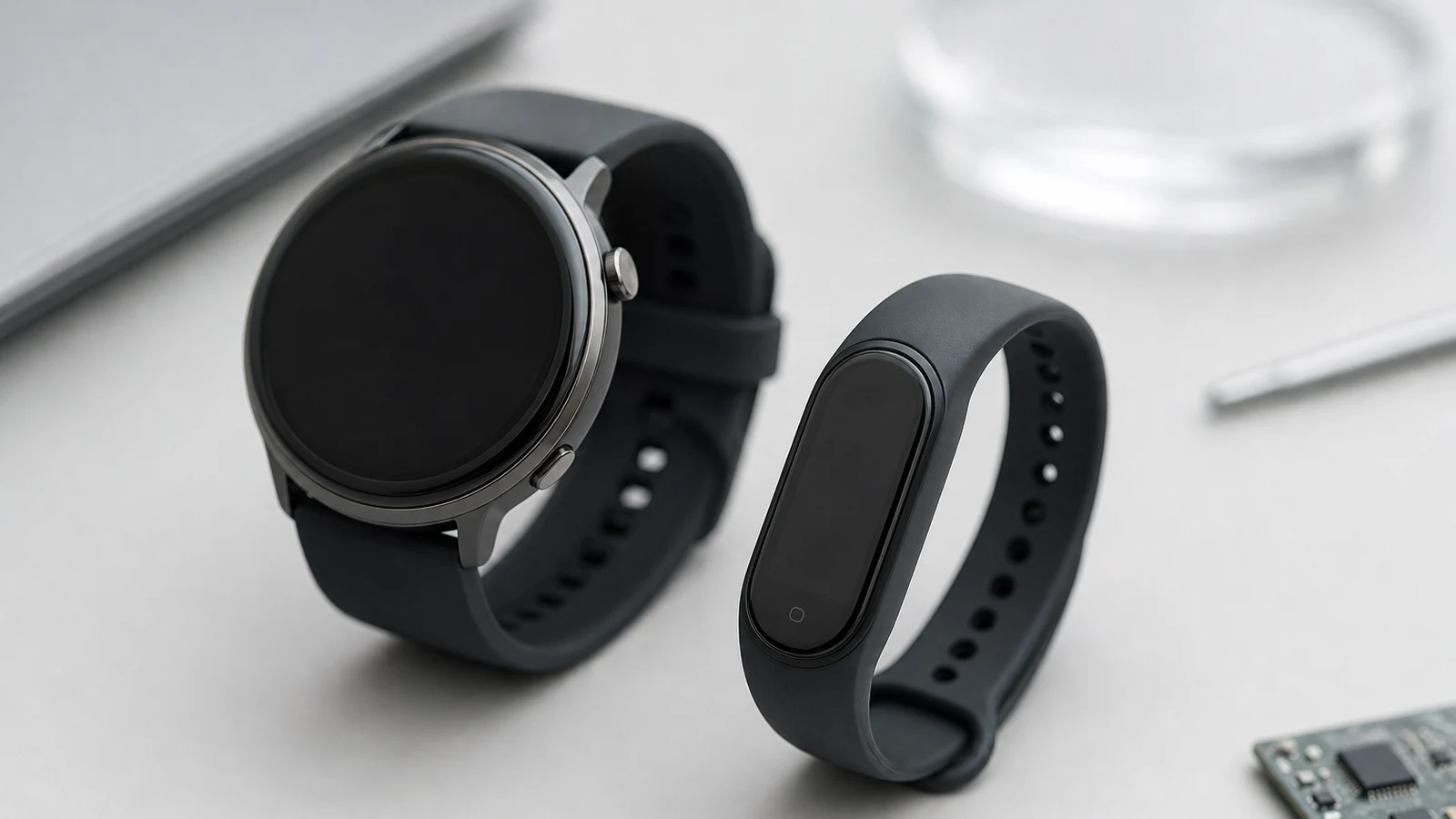
Wearables look simple from the outside — a small enclosure, a sensor, a battery, maybe an app. In practice, they're one of the least forgiving categories in hardware. Every design decision competes for the same few cubic centimeters, and unlike a desktop product, a wearable has to survive being worn: sweat, motion, drops, and days of continuous use on a single charge.
At CoBuild Labs, we've taken wearable concepts from a napkin sketch to a working prototype across consumer, medical, and driver-safety use cases. This is the roadmap we walk founders through — and the tradeoffs that tend to catch first-time teams off guard. If you're building in this space, pair this guide with our hardware product development services and browse related builds in our Work portfolio.
Start with the constraint that won't move
Every wearable project has one non-negotiable constraint — the thing that, if you get it wrong, no amount of clever engineering later fixes it. Figure out what yours is before touching CAD or a schematic:
- Battery life for a fitness band worn 24/7
- Form factor for a ring or earbud where every 0.1 mm matters
- Regulatory pathway for a medical-grade patch or monitor
- Signal fidelity for a sensor product where the data is the product
Naming this constraint early changes the order of operations. A battery-life-first product starts with power budgeting before industrial design. A form-factor-first product starts with mechanical stack-up before firmware architecture. Teams that skip this step tend to design the enclosure they want, then discover it can't fit the battery or antenna they need — and the fix is a full mechanical respin through mechanical engineering.
Mechanical: designing around the body, not the desk
Wearable enclosures deal with constraints a stationary product never sees:
- Skin contact and thermal limits — continuous skin-contact surface temperatures are tightly regulated, which limits how hard you can push processing or charging current
- Ingress protection — sweat and moisture resistance (typically IP54–IP67) shapes seam design, buttons, and charging-port choice from day one
- Wear comfort and strap/band interfaces — these are mechanical engineering problems, not afterthoughts; poor strap tension distribution is a common cause of returns
- Antenna placement — a metal case or body-worn position can detune a BLE antenna significantly; this has to be modeled early, not tested after tooling
A 3D-printed enclosure that fits on a bench is not the same as one that survives a week on someone's wrist. We push wearable prototypes through actual wear testing — sweat exposure, motion, repeated charging cycles — before committing to tooling. That workflow lives inside our prototyping practice.
Electrical: the power budget is the real spec
For most wearables, the electrical design conversation isn't about clock speed — it's about milliamps. A realistic power budget, built line by line across every subsystem, should exist before schematic capture starts. The gap between "active" and "sleep" current is where battery life is won or lost.
That pushes decisions upstream: sensor sampling strategy, radio duty cycling, and even PCB layout (trace resistance matters at these current levels). Charging circuitry adds its own constraints — wireless coils compete with antennas for board space, and USB-C ports need sealing if the product gets wet. Our electrical engineering team treats the power budget as a first-class deliverable, not a spreadsheet footnote.
Firmware: built for interruption, not continuity
Wearable firmware has to assume it will lose the BLE connection repeatedly, get put on a charger mid-operation, and spend most of its life in low-power sleep interrupted by sensor reads. That means architecture around:
- Aggressive but safe power states, with fast wake paths from interrupts
- Connection resilience and data buffering so a dropped BLE link doesn't mean lost data
- OTA updates from day one — a wearable without a field-update path is one bug away from a recall
- On-device sensor fusion where raw accelerometer or PPG data is rarely useful alone
For deeper firmware patterns on connected products, see how we approach firmware engineering. Biosensor-heavy wearables should also read Choosing the Right Biosensors for Medical Devices.
Prototyping: proving it before you tool it
For wearables specifically, we recommend at least two distinct prototype stages:
- Proof-of-concept — validate sensor, radio, and power architecture on off-the-shelf modules before any custom PCB exists
- Engineering prototype — custom PCB plus 3D-printed or CNC enclosure, tested for fit, comfort, and thermal behavior
Skipping straight from breadboard to tooled enclosure is the most expensive mistake we see. A sensor that reads perfectly on a dev kit can behave completely differently once it's pressed against skin inside a sealed enclosure. De-risk that path with Validate Before You Tool before you cut molds.
Where certification fits in
If your wearable makes any health claim — heart rate, SpO2, sleep tracking beyond "wellness" — the regulatory pathway needs to be decided during concept, not after the first prototype works. Radios (BLE, Wi-Fi) also mean FCC/CE compliance regardless of health claims. Align early with product certificationso documentation and test plans aren't bolted on at the end.
Bringing it together
A wearable prototype ready to scale isn't just one that works on a bench — it has already survived being worn: power budgets that hold up over a full day, an enclosure that seals against sweat, firmware that recovers from a dropped connection, and a regulatory path chosen before the design was locked. That's the difference between a demo and a product.
Ready to map your wearable roadmap? Talk to CoBuild Labs — or explore how continuous cardiac sensing is evolving in The Smart Devices Learning to Listen to Your Heart.