
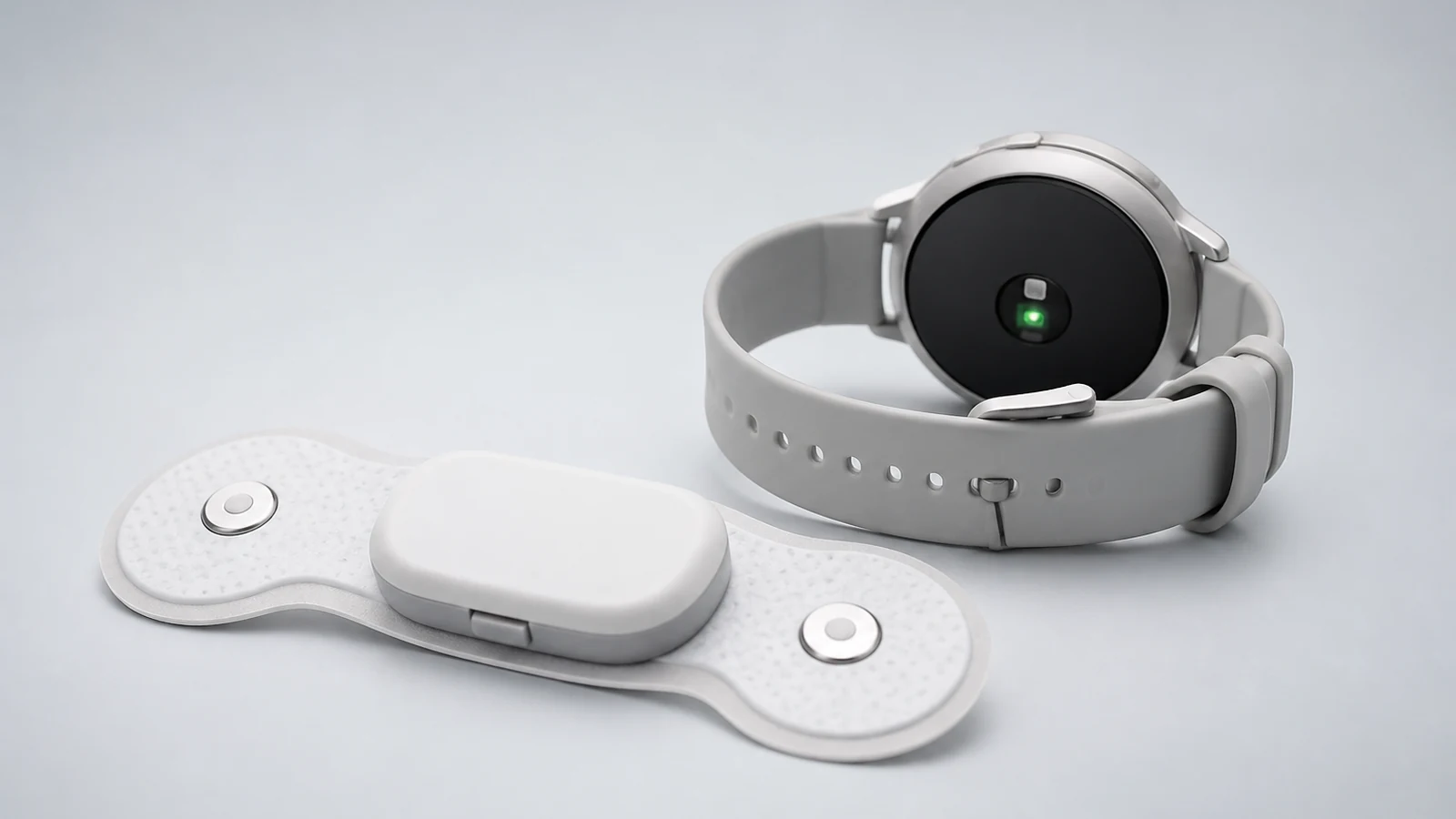
Cardiovascular disease is the leading health crisis of our time. The number of people living with it has nearly doubled since 1990 — from 271 million to 535 million — and it now causes close to 20 million deaths a year. About a third of those deaths happen before age 70.
For decades, hospital tools like echocardiograms and ECGs have captured single snapshots in time. They can't follow you home or catch the irregular heartbeat at 3 a.m. Wearable cardiovascular sensors aim to close that gap. This overview draws on a recent scientific review of the field (Nature review) — and connects it to how hardware teams actually ship these systems.
Reading your pulse with light
Photoplethysmography (PPG) — the tech behind most smartwatch heart-rate sensors — shines light into skin and measures how much returns as blood pulses through capillaries. Transmissive PPG (through a fingertip) is more accurate but bulky; reflective PPG suits wristbands with slightly less precision. Better materials, algorithms, ultra-thin sensors, and even solar-powered designs are closing the gap.
Feeling the pulse instead of seeing it
Pressure-based sensors (resistive, capacitive, magnetic, piezoelectric, triboelectric) convert the mechanical push of a heartbeat into an electrical signal. Some versions work underwater or through sweat — conditions where optical wearables often fail. That mechanical interface is a mechanical engineering problem as much as a sensor problem.
Watching the heart's electrical signal, no wires required
- Wet electrodes — gel-based patches, including hydrogels wearable for a week+
- Dry electrodes — gel-free structures inspired by biology for sweat and motion
- Non-contact sensors — pick up signals through clothing or bedsheets for elderly care and overnight monitoring
Choosing among these modalities is exactly the decision framework in Choosing the Right Biosensors for Medical Devices. Several of our Work case studies — including wearable ECG and respiratory platforms — live in this design space.
The long quest for cuffless blood pressure
Inflatable cuffs aren't all-day wearables. Alternatives include wearable ultrasound for deeper vessels, wrist pressure sensors estimating BP from pulse morphology, and multi-sensor ECG+PPG pulse-transit methods. Calibration remains hard — but commercial smartwatches already offer limited BP tracking.
Seeing blood flow, wearable ultrasound, and biochemical markers
Thermal and Doppler sensors track circulation changes that often precede clots, aneurysms, or heart failure. Flexible ultrasound patches can image continuously during movement — some research devices monitor central BP, heart rate, and cardiac output for hours from a soft skin patch.
Biochemical sensing from sweat, saliva, and tears (glucose, cholesterol, lactate, cortisol, inflammatory markers) points toward continuous chemical insight without drawing blood — especially when fused with ECG/PPG streams via on-device AI.
From watching to warning to acting
Multi-sensor early-warning systems (ECG + temperature + BP) can flag stroke risk, sleep apnea, or atrial fibrillation with high research accuracy. Closed-loop systems go further — like CGM-driven insulin delivery — automatically acting on sensor data. Hardware teams shipping these products need reliable firmware, low-noise electronics, and a clear certification pathway from day one.
What's still standing in the way
- Comfort vs durability for long wear
- Motion and sweat degrading signal quality
- The next leap: fusing multiple signals with deep learning for richer cardiac insight from small patches
The bigger picture
We're moving from healthcare that happens in occasional appointments toward continuous, background monitoring — exactly where silent conditions are hardest to catch early. There's real engineering work ahead, but the trajectory is clear.
If you're building a cardiac or physiological wearable, start with constraints and validation (wearable prototyping, Validate Before You Tool), then talk to CoBuild Labs about turning the sensing stack into a production-ready prototype.