
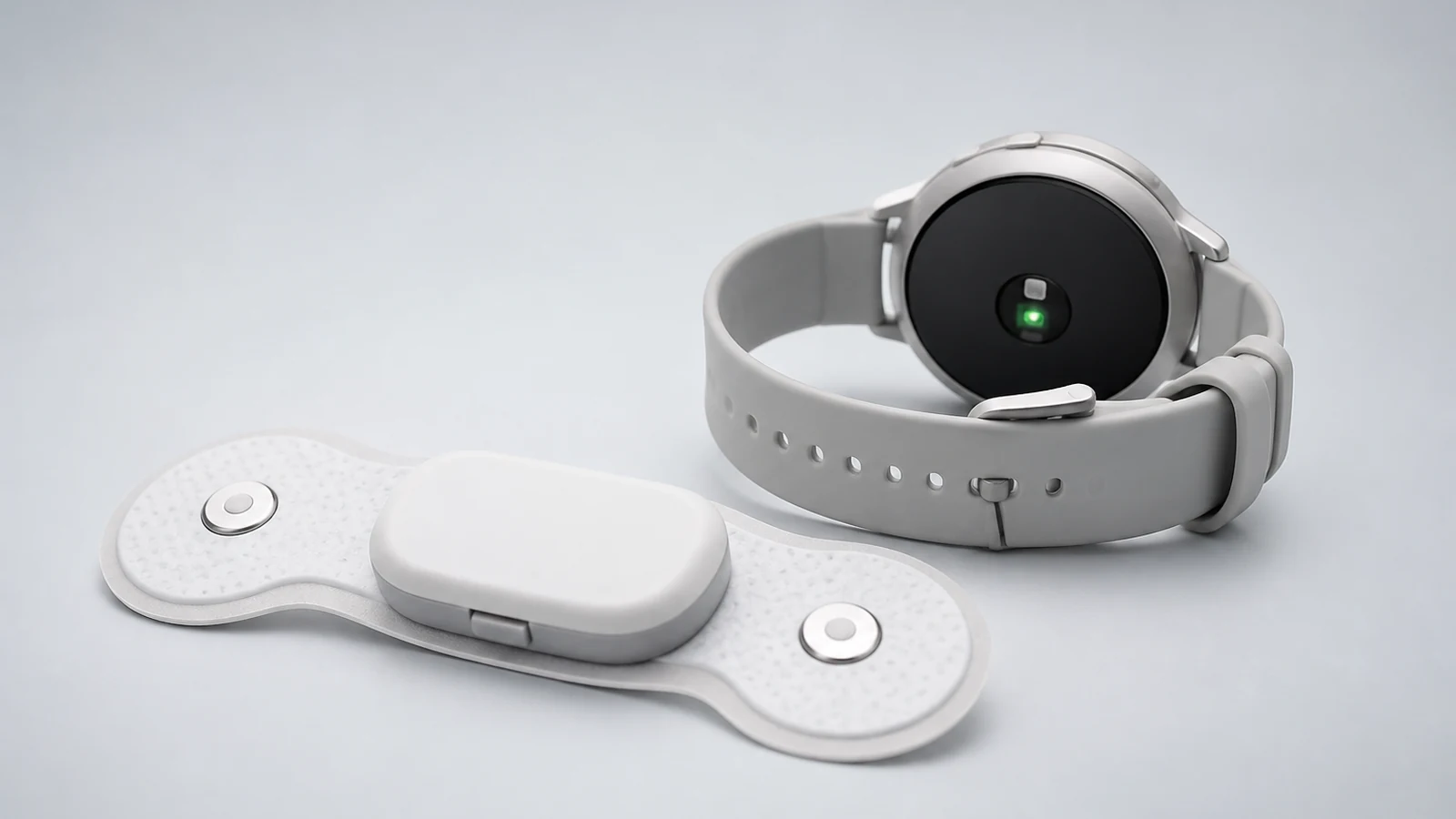
Blood pressure monitoring has traditionally relied on an inflatable cuff wrapped around the upper arm. While cuff-based devices remain the clinical standard, they aren't ideal for continuous monitoring — they provide only occasional readings and can be inconvenient for everyday use.
Wearable devices are now exploring a different approach: cuffless blood pressure monitoring.
By combining optical sensors such as photoplethysmography (PPG), electrical signals such as ECG, motion sensing, and advanced algorithms, next-generation wearables are attempting to estimate blood pressure continuously and non-invasively.
But how does a smartwatch or wearable actually estimate blood pressure without inflating a cuff?
What Is Cuffless Blood Pressure Monitoring?
Cuffless blood pressure monitoring refers to techniques that estimate blood pressure without using a traditional inflatable cuff.
Instead of directly measuring arterial pressure, most wearable systems measure physiological signals related to cardiovascular activity, then use signal-processing algorithms and mathematical or machine-learning models to estimate parameters such as:
- Systolic Blood Pressure (SBP)
- Diastolic Blood Pressure (DBP)
- Mean Arterial Pressure (MAP)
The fundamental challenge is that blood pressure is not directly observable from a standard PPG signal. The wearable therefore needs to extract features that correlate with changes in blood pressure.
The Role of PPG in Blood Pressure Monitoring
Photoplethysmography (PPG) is one of the most widely used sensing technologies in modern wearables. A PPG sensor typically consists of:
- One or more LEDs
- A photodiode
- Analog front-end electronics
- Signal-processing circuitry
The LED illuminates the skin while the photodiode detects changes in reflected or transmitted light caused by variations in blood volume. Each heartbeat produces a characteristic change in the optical signal.
A simplified PPG waveform can provide information about:
- Heart rate
- Pulse timing
- Pulse amplitude
- Pulse waveform morphology
- Pulse transit characteristics
- Vascular changes
These features can potentially be related to blood pressure. However, PPG alone generally does not provide a direct measurement of arterial pressure.
Why ECG + PPG Can Be More Useful
One important approach being investigated for cuffless BP estimation is the combination of ECG and PPG.
ECG provides information about the electrical activation of the heart, while PPG provides information about the arrival of the resulting pulse wave at a peripheral location. The time relationship between these signals can be used to calculate a parameter known as Pulse Transit Time (PTT) or, depending on the measurement definition, Pulse Arrival Time (PAT).
Conceptually:
ECG → heart electrical activation → blood ejection → arterial pulse → PPG detection
The time difference between relevant points in these signals can provide information related to arterial stiffness.
Pulse Transit Time and Blood Pressure
Pulse waves travel through arteries at a speed that depends on the mechanical properties of the arterial system. When arterial stiffness changes, pulse-wave velocity can also change.
Pulse Transit Time is approximately related to pulse-wave velocity as:
PTT ≈ Distance / Pulse Wave Velocity
In general, increased arterial stiffness is associated with faster pulse-wave propagation and therefore shorter transit times. Because blood pressure and vascular stiffness are related, PTT can potentially be used as one input for estimating blood pressure — but this relationship isn't universal or perfectly linear.
Factors that can influence the measured signals include:
- Age
- Arterial stiffness
- Skin temperature
- Vascular tone
- Body position
- Physical activity
- Stress
- Hydration
- Sensor placement
Therefore, a wearable cannot simply measure PTT and convert it directly into an accurate blood-pressure value for every person.
The Importance of Machine Learning
Modern cuffless BP systems increasingly rely on signal processing and machine-learning algorithms. A typical system can be represented as:
ECG + PPG + IMU + Temperature → Signal Processing → Feature Extraction → ML Model → BP Estimation
The system may extract features such as:
- From ECG
- R-peak timing
- Heart rate
- RR interval
- ECG morphology
- From PPG
- Pulse arrival time
- Pulse amplitude
- Rise time
- Pulse width
- Systolic peak characteristics
- Diastolic characteristics
- Waveform derivatives
- Pulse morphology
- From IMU
- Movement
- Wrist orientation
- Activity level
- Motion artifacts
- From Temperature
- Peripheral temperature
- Changes in vascular condition
These features are then fed into a regression or machine-learning model. Possible algorithms include linear regression, polynomial regression, random forest, gradient boosting, support vector regression, neural networks, and deep learning models. The objective is to learn the relationship between physiological features and reference blood-pressure measurements.
Why IMU Data Is Important
One of the biggest problems with wearable sensing is motion artifact. A user may be walking, running, moving their wrist, changing posture, exercising, or talking or gesturing — all of which can significantly distort PPG and other biosignals.
An IMU containing an accelerometer and gyroscope can provide information about the user's movement. This information can be used to:
- Detect periods of high motion
- Identify corrupted signal segments
- Select reliable signal windows
- Assist adaptive filtering
- Provide activity context to an estimation algorithm
This is one reason future BP wearables are likely to rely on multimodal sensing rather than a single sensor.
Why Cuffless BP Is Difficult
Although the concept is attractive, achieving reliable cuffless blood-pressure estimation is technically challenging.
- 1. Individual physiological differences Two people can have similar PPG and PTT values but different blood pressures. Factors such as arterial stiffness, vascular structure, age, and cardiovascular condition affect the relationship.
- 2. Calibration Many systems require calibration against a conventional blood-pressure measurement. The challenge is that the relationship between the wearable signal and blood pressure can change over time — a calibration performed today may not remain equally accurate weeks or months later.
- 3. Motion artifacts Movement can significantly affect optical signals, particularly when the sensor is worn on the wrist.
- 4. Sensor placement Small changes in sensor pressure, sensor position, wrist orientation, and skin contact can change PPG waveform characteristics.
- 5. Temperature and blood flow Peripheral blood flow changes with temperature and environmental conditions, which can influence optical measurements.
- 6. Dynamic blood-pressure changes Estimating relatively stable BP is different from tracking rapid changes caused by exercise, stress, standing up, sitting down, sleep, caffeine, or medication. A system must perform reliably across all these physiological states.
Why Sensor Placement Matters
The location of the wearable has a major impact on signal quality.
- Wrist — Convenient and widely accepted for consumer wearables, but presents challenges: lower peripheral blood volume, high motion, variable sensor pressure, and anatomical differences between users.
- Finger — Generally provides a stronger optical signal due to better peripheral perfusion, though it may be less convenient for continuous everyday use.
- Ear — Can provide excellent physiological signals because of relatively stable blood flow and lower motion compared with the wrist, making it an interesting platform for future cardiovascular monitoring.
- Chest — Provides an excellent location for ECG acquisition and can enable accurate ECG–PPG timing measurements when combined with a peripheral PPG sensor.
A Typical Cuffless BP Wearable Architecture
A practical wearable system may contain several sensing blocks, working together as follows:
- PPG Sensor → Captures optical pulse waveform
- ECG Sensor → Provides cardiac electrical timing
- IMU → Detects movement and posture
- Temperature Sensor → Provides environmental/peripheral temperature data
- AFE + MCU → Signal acquisition and preprocessing
- BLE → Data transmission
- Mobile App / Cloud → Data storage and visualization
- AI / ML Algorithm → Blood-pressure estimation
This architecture reflects the direction in which multimodal wearable health monitoring is evolving.
From Raw Signal to Blood Pressure
The complete development process can be divided into several stages:
- Signal Acquisition — Acquire synchronized ECG, PPG, and IMU data.
- Signal Quality Assessment — Identify whether the acquired signals are sufficiently clean for analysis.
- Preprocessing — Apply appropriate filtering and artifact-reduction techniques.
- Feature Extraction — Extract cardiovascular features from ECG and PPG.
- Ground-Truth Measurement — Collect simultaneous reference BP measurements using a validated reference device.
- Dataset Creation — Record data across a diverse range of users, BP values, activities, body positions, and physiological conditions.
- Model Development — Train and validate the estimation algorithm.
- Calibration — Develop a user-specific or population-based calibration strategy.
- Validation — Evaluate the system against reference measurements using appropriate accuracy and agreement metrics.
- Wearable Integration — Optimize for size, power consumption, sensor placement, comfort, BLE communication, real-time processing, and long-term reliability.
What Does the Future Look Like?
The future of blood-pressure monitoring is likely to move toward continuous, unobtrusive, and multimodal sensing. Instead of relying on a single sensor, future wearable systems may combine ECG, PPG, IMU, temperature, bioimpedance, and AI.
The objective isn't simply to measure blood pressure once — the bigger opportunity is to understand how cardiovascular parameters change continuously throughout the day. This could enable applications such as:
- Long-term cardiovascular monitoring
- Hypertension management
- Sleep monitoring
- Exercise monitoring
- Stress and recovery analysis
- Remote patient monitoring
- Early detection of physiological changes
However, cuffless BP estimation shouldn't be treated as a simple software problem. Sensor architecture, electrode/optical design, signal quality, calibration, dataset quality, and validation are all equally important.
The Engineering Challenge
Developing a cuffless BP wearable requires expertise across multiple disciplines:
- Sensor Selection — Choosing appropriate PPG, ECG, IMU, and other sensing technologies
- Analog Front-End Design — Achieving high-quality physiological signal acquisition with low power consumption via electrical engineering
- Mechanical & Industrial Design — Maintaining stable sensor contact while keeping the device comfortable
- Embedded Firmware — Synchronizing multiple sensors and processing signals in real time
- Signal Processing — Filtering noise and motion artifacts while preserving physiological information
- Machine Learning — Developing models that can estimate BP from multimodal physiological features
- Validation — Comparing wearable estimates against appropriate reference measurements
The combination of these disciplines is what turns a promising sensing concept into a functional wearable product.
Conclusion
Cuffless blood-pressure monitoring represents one of the most interesting areas in wearable health technology. PPG provides a convenient way to capture peripheral cardiovascular information, while ECG provides cardiac timing information. When these signals are combined with motion sensing, temperature measurements, and machine-learning algorithms, they can provide valuable inputs for estimating blood pressure.
But the key challenge is reliable, generalizable, and clinically meaningful estimation across different users and real-world conditions. The next generation of wearable BP technology will depend not on one breakthrough sensor, but on the integration of high-quality sensing, robust signal processing, multimodal data fusion, personalized calibration, and rigorous validation — the same stack we cover in biosensor selection and cardiovascular wearables.
At CoBuild Labs, wearable sensing systems can be approached as an end-to-end engineering problem — from sensor and AFE selection to PCB design, firmware, signal processing, mechanical integration, and prototype validation.
Building a cuffless BP or multimodal wearable? Talk to CoBuild Labs — start from our wearable prototyping guide, review FDA clearance for wearables, or browse related Work case studies.