
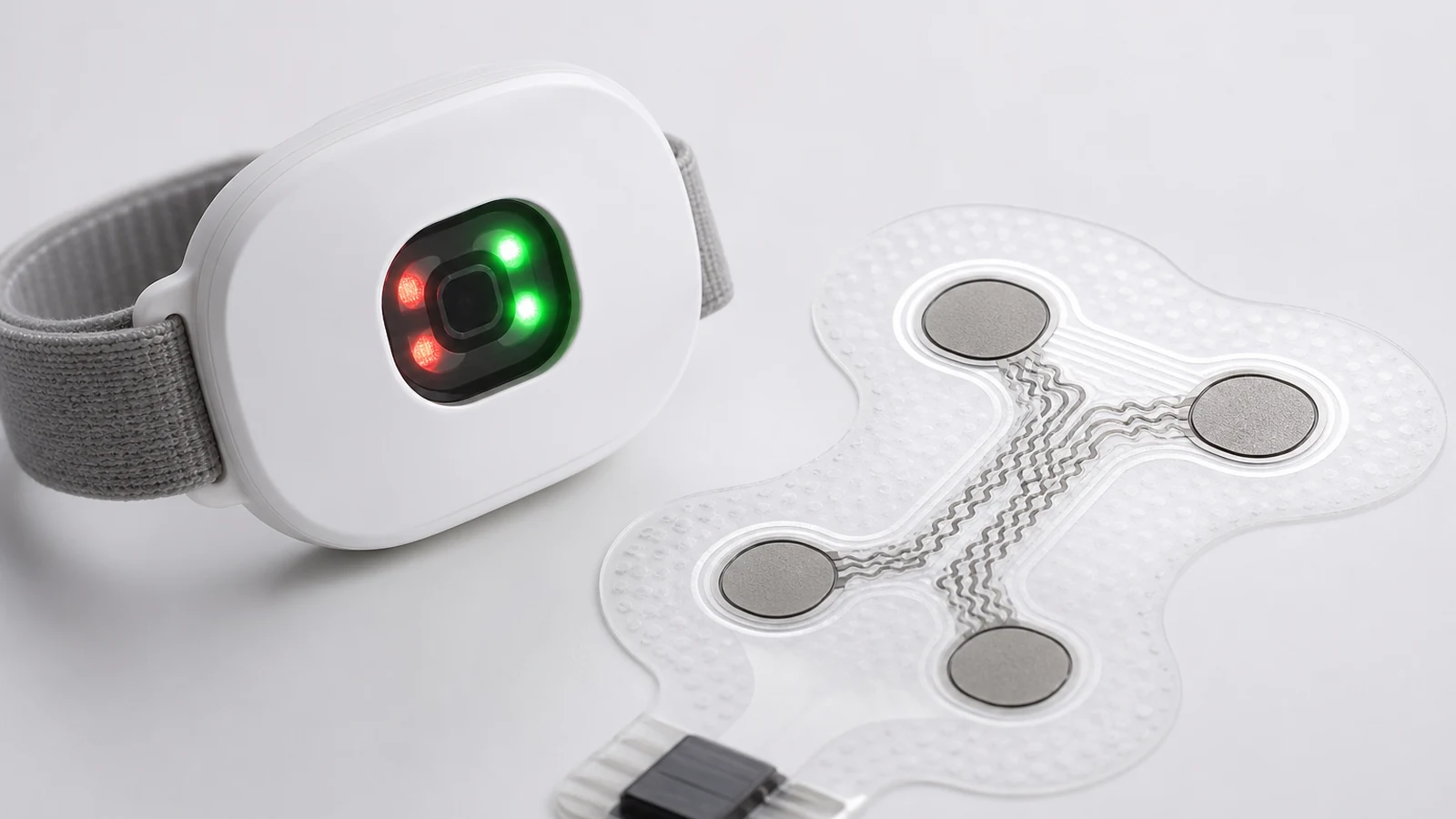
The biosensor is usually the first component picked on a medical device project — and often the one revisited the most times before production. The sensor choice doesn't just determine what data you can capture; it determines your regulatory pathway, mechanical design, power budget, and how believable your clinical claims are.
At CoBuild Labs, biosensor selection is one of the first conversations we have with medical device teams, well before schematic capture. Here's the framework we use — especially useful if you're also planning a wearable prototype.
Start with the claim, not the sensor
The single most common mistake is choosing a sensor because it's popular or easy to source, then figuring out what claim it can support. Reverse that order. The claim — diagnostic, therapeutic monitoring, or general wellness — determines the accuracy, validation, and documentation bar, which narrows sensor options dramatically.
A pulse oximeter making a clinical SpO2 claim and a wellness ring displaying a "readiness score" might use similar optical hardware, but they sit in entirely different regulatory categories. Decide the claim first. It will save a redesign later — including how you approach product certification.
Common sensing modalities and where they fit
Most modern medical wearables aren't single-sensor devices — they fuse two or more modalities to compensate for weak points. A PPG-only heart rate sensor struggles during motion; adding an accelerometer lets firmware recognize and compensate for motion artifact rather than reporting a bad reading with false confidence. That fusion work often lands in firmware and AI integration.
For a deeper look at cardiovascular sensing stacks (PPG, pressure, ECG, ultrasound, biochemical), see wearable cardiovascular sensors.
Accuracy on a datasheet isn't accuracy on a body
Datasheet specs are almost always measured under lab conditions — controlled temperature, ideal contact, minimal motion. None of that resembles a device on a moving, sweating, unevenly perfused human body. Before committing, ask:
- What population was it validated on? Optical sensors have documented accuracy variance across skin tones and perfusion states.
- What's the motion tolerance for ambulatory or activity-based monitoring?
- What's the warm-up and settling time after donning?
- How does contact quality get detected and communicated to the user or clinician?
Whatever the datasheet says, plan a real-world validation study on your target population, in your actual form factor, before you trust a number in marketing or clinical claims.
Integration constraints: mechanical, electrical, and consumable
- Mechanical. Optical sensors need controlled contact pressure and ambient light shielding — this shapes enclosure and strap design via mechanical engineering.
- Electrical. Electrochemical sensors often need precision AFEs and careful noise isolation from digital/BLE circuitry — a core job for electrical engineering.
- Consumables. Some sensing elements have shelf lives and storage requirements that become supply-chain problems, not just engineering ones.
- Power. Sampling strategy is one of the biggest levers on battery life in continuous monitoring — see our wearable prototyping guide.
Regulatory weight shifts with the sensor
A device using a well-characterized, previously-cleared sensing approach for an established use case has a shorter path than one using a novel sensor or a novel claim. Map this with regulatory counsel during sensor selection — not after a prototype already works.
Building in validation from day one
- Bench characterization against datasheet specs with controlled inputs
- Phantom or simulated testing where applicable (PPG, bioimpedance)
- Human factors and usability testing across realistic body types
- Clinical or field validation sized for your regulatory pathway
Skipping straight from bench to clinical study is how teams discover expensive problems late. Sequence validation the same way you sequence hardware risk in Validate Before You Tool.
Bringing it together
Choosing a biosensor isn't a component-selection exercise — it sets your regulatory pathway, shapes mechanical and electrical architecture, and defines the validation work ahead. Start from the claim, treat datasheet accuracy as a hypothesis, and build real-world validation into the first prototype — not the last one.
Need help selecting and integrating a sensing stack? Contact CoBuild Labs or review related medical platforms in our case studies.