
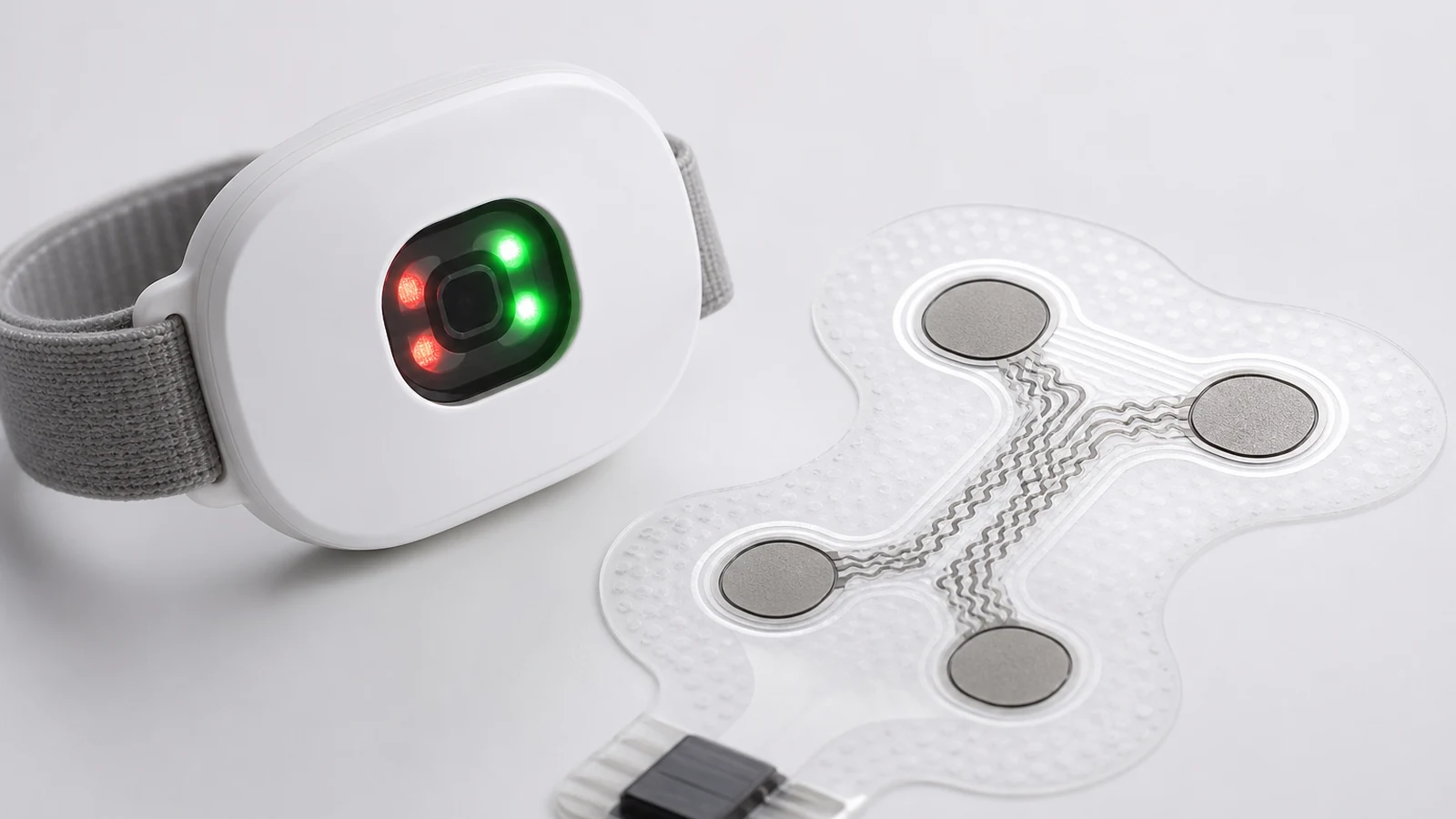
A few years ago, a heart-rate strap and an FDA-cleared ECG sensor lived in completely different product categories. That line has been blurring fast. In 2025 alone, WHOOP added an FDA-cleared ECG feature to its wrist-worn strap, and Dexcom cleared a 15-day continuous glucose monitor with industry-leading accuracy. Consumer wearables are increasingly stepping into regulated medical-device territory — and for hardware teams, that shift changes almost everything about how a product needs to be engineered, validated, and documented.
This post breaks down what FDA clearance actually requires, using recent wearable examples, and what hardware teams need to plan for early — not after the design is frozen. Pair this with our product certification process and dual-compliance design guidance.
Clearance vs. Approval: A Distinction That Matters
"FDA-cleared" and "FDA-approved" are often used interchangeably in casual conversation, but they refer to two different regulatory pathways with different risk thresholds:
- 510(k) Clearance — for low-to-moderate risk (Class I/II) devices that can demonstrate substantial equivalence to an already-legally-marketed "predicate" device
- PMA (Premarket Approval) — the more rigorous pathway required for high-risk (Class III) devices
- De Novo Classification — a pathway for novel low-to-moderate risk devices that have no existing predicate
- Nearly all wearable health devices — smartwatches with ECG, CGMs, pulse oximeters — go through the 510(k) route. The vast majority of medical devices entering the U.S. market use this pathway rather than the more demanding PMA process.
The Predicate Device: Your Starting Point, Not an Afterthought
The core of a 510(k) submission is proving your device is "substantially equivalent" to a predicate — an existing, legally marketed device with a similar intended use and similar technology.
This is exactly the strategy WHOOP used for its ECG feature. When WHOOP submitted its single-channel ECG feature for clearance, it used Apple's ECG App as its predicate device, mapping its indications for use, product code, device classification, and core technology almost line-for-line against Apple's earlier clearance. The resulting device — cleared as a software-only mobile medical application intended for use with the WHOOP Strap — can detect atrial fibrillation, normal sinus rhythm, and low or high heart rate on a classifiable single-lead waveform.
The engineering lesson here: identifying a viable predicate device should happen at the concept stage, not after the hardware is built. The predicate shapes what technical comparisons, performance data, and risk documentation you'll eventually need to produce — so choosing (or ruling out) a predicate early can save months of rework later.
What "Clinical Validation" Actually Means
- Getting cleared isn't just a paperwork exercise — it requires demonstrating that your sensor and algorithm perform reliably against a clinical reference standard. Two recent examples show what this looks like in practice for different sensing modalities.
Case 1: ECG / Arrhythmia Detection (WHOOP)
For rhythm-classification devices, validation means running structured clinical performance studies that compare the wearable's classification output — AFib, normal sinus rhythm, high/low heart rate, or inconclusive — against simultaneous readings from a reference-grade ECG monitor, across a large and diverse patient population. Sensitivity and specificity for each rhythm category are the key metrics regulators look for.
Case 2: Continuous Glucose Monitoring (Dexcom)
For continuous analyte-sensing devices, the industry-standard accuracy metric is MARD — Mean Absolute Relative Difference — the average percentage error between the sensor's reading and a laboratory reference measurement, with a lower MARD indicating better accuracy.
When Dexcom's G7 15-Day CGM system was cleared in April 2025, the clearance was backed by a clinical study of 130 adults with type 1 or type 2 diabetes, generating over 20,000 matched sensor-to-lab reference pairs using a Yellow Springs Instrument glucose analyzer as the gold-standard comparator. The system achieved an overall MARD of 8.0%, with the vast majority of readings falling within 15-20% agreement of the lab reference. Anything under roughly 10% MARD is generally considered clinically reliable for a CGM.
The pattern across both examples: regulators aren't just asking "does the sensor work?" — they want statistically powered studies against an accepted reference method, run across a population large and diverse enough to generalize.
The Regulatory Landscape Is Shifting Under Wearable Teams' Feet
A few structural changes are worth planning around right now:
- 1. Quality Management System Regulation (QMSR) As of February 2026, the FDA's Quality System Regulation has transitioned to align with the international ISO 13485:2016 standard. For hardware teams, this means design controls, risk management, and documentation practices need to be built into the development process from day one — not retrofitted before submission.
- 2. Cybersecurity requirements have tightened significantly Updated FDA guidance issued in early 2026 has raised the bar on cybersecurity documentation across the full device lifecycle — a critical consideration for any connected wearable transmitting health data over BLE or Wi-Fi.
- 3. Submissions are getting longer and more data-heavy The average 510(k) submission has more than doubled in length in recent years, reflecting the FDA's rising expectations for supporting scientific and performance data — a trend that shows no sign of reversing.
- 4. Review timelines have lengthened Median review times for 510(k) submissions have stretched due to the additional cybersecurity and documentation scrutiny — a factor that should be built into product launch timelines rather than discovered midway through submission.
What This Means for Hardware Teams Building Wearables
If a wearable's roadmap includes any features that touch physiological measurement — heart rhythm, blood oxygen, glucose, blood pressure, respiration — a few engineering decisions early in the process can make or break the eventual clearance timeline:
Identify a predicate device (or confirm none exists) before finalizing sensor architecture. This determines whether you're headed toward a comparatively faster 510(k) pathway or a longer De Novo submission.
Design for clinical-grade signal quality from the start, not as a later software patch — because the AFE, sensor placement, and mechanical design directly determine whether the raw signal can support the accuracy claims you'll need to validate.
Bake in design controls and risk documentation from day one, rather than reconstructing a paper trail retroactively — this is now effectively mandatory under QMSR.
Plan clinical validation study logistics early, including partnering with a reference-grade comparator device and securing a large enough, diverse enough participant pool.
Treat cybersecurity architecture as a first-class requirement, not a bolt-on before submission — this is one of the fastest-growing areas of FDA scrutiny for connected devices.
Conclusion
The line between "fitness gadget" and "medical device" is no longer about how a company markets its product — it's about whether the sensing, signal processing, and validation behind it can survive clinical-grade scrutiny. As more wearable categories chase regulatory clearance — from ECG to CGM to eventual cuffless blood pressure and non-invasive glucose monitoring — the hardware teams that treat clinical validation and regulatory strategy as day-one engineering constraints, rather than end-of-project paperwork, will be the ones that get to market fastest.
At CoBuild Labs, we approach connected health wearables as a regulated-device engineering problem from the outset — aligning sensor selection, AFE design, firmware, and validation planning with the clinical and regulatory bar — see dual compliance by design.
Planning a regulated wearable path? Talk to CoBuild Labs about certification, prototyping, and related reading on validating before tooling.