
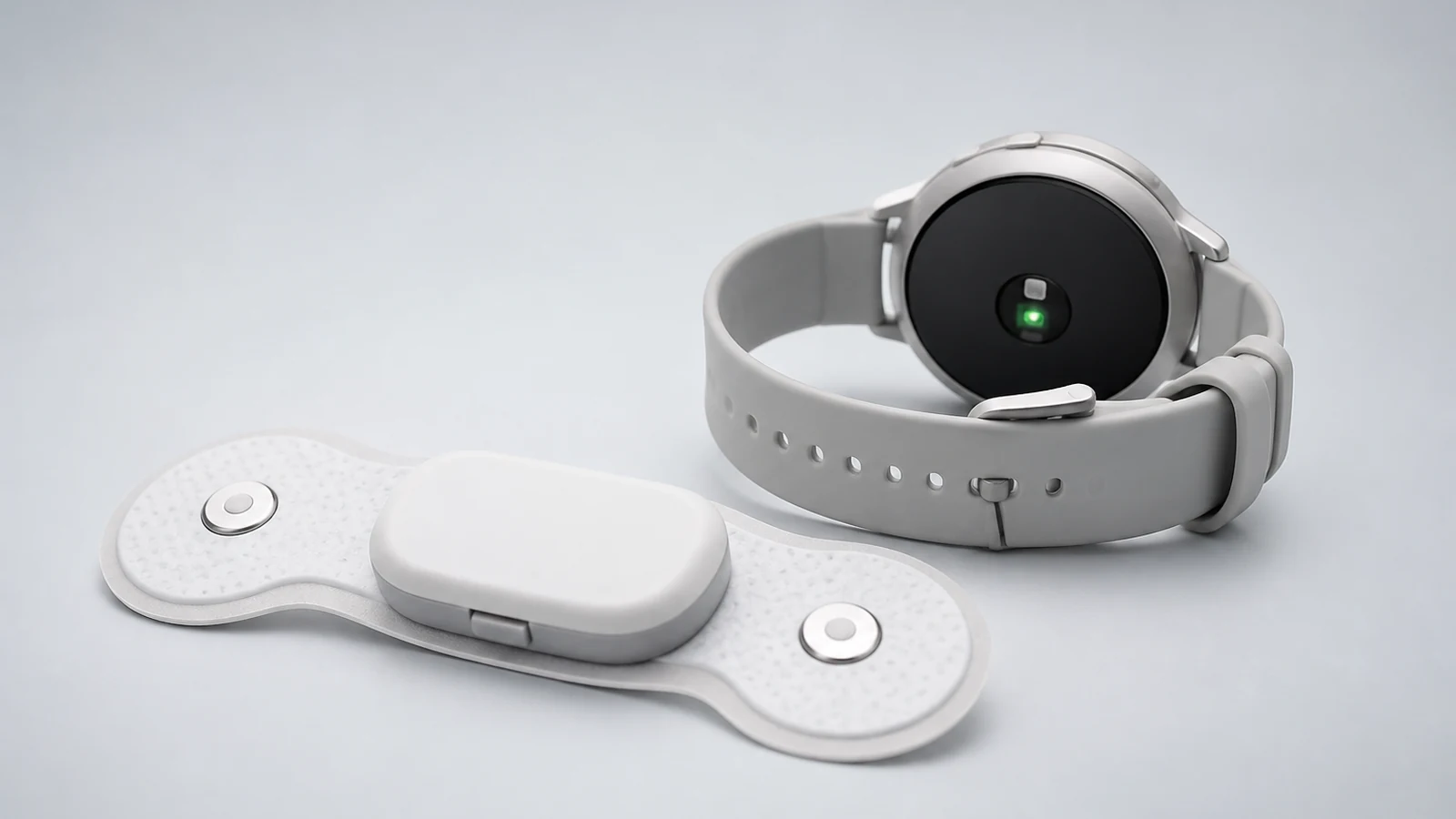
By the time a passenger consciously realizes they feel sick, their body has usually already been signaling it for a minute or more. Motion sickness doesn't arrive instantly — it builds through a measurable physiological progression: a stress response gives way to autonomic changes long before nausea registers as a conscious sensation. That gap between the physiological onset and the subjective "I feel sick" moment is exactly the window a wearable device could exploit — and it turns out the sensors already sitting on millions of wrists (PPG, EDA, temperature, motion) are largely the right tool for the job.
This post looks at the physiological markers that precede motion sickness, what the research shows about detecting them through wearables, and how this connects back to the PPG and EDA sensing already covered in our wearable and driver-cabin content.
The Physiological Signature of Getting Sick
Motion sickness triggers a fairly well-characterized autonomic nervous system cascade, and a few signals stand out as consistently useful markers across the research.
Heart rate variability (HRV) shifts as an early autonomic signal. HRV and ECG provide complementary views into autonomic nervous system activity that can support motion sickness assessment, and reliable HRV markers are increasingly viewed as a route to early detection and continuous monitoring in real-world contexts like autonomous vehicles, where passenger comfort and safety are genuinely at stake. HRV generally decreases under stress due to reduced parasympathetic activity — a pattern that shows up well before a passenger would describe themselves as nauseous.
Electrodermal activity (EDA) tracks the body's sympathetic arousal directly. EDA measures sweat gland activity as a marker of sympathetic nervous system arousal, and studies inducing motion sickness under controlled conditions have specifically used EDA to capture the sweating response associated with the condition. One detailed physiological progression, described in a patent for an autonomous-vehicle sickness detection system, lays out the actual sequence clearly: a stress response typically begins with increased heart rate and a rise in galvanic skin response at the fingers, with skin temperature changes at the fingers following roughly a minute later — a documented, sequential cascade rather than a single simultaneous symptom onset.
Skin and facial temperature reflect the "feeling of warmth or pallor" that often precedes nausea. Body and facial skin temperature have been specifically selected in motion sickness research because they reflect the sensations of warmth and pallor that are among the condition's recognizable early signs — a signal PPG-adjacent temperature sensors can pick up passively.
Respiration and body movement round out the picture. Broader research protocols combine cardiovascular measures, EDA, respiration, and body movement specifically because each reflects a different cardinal sign of motion sickness — respiration for general discomfort, EDA for sweating, temperature for pallor — meaning no single signal alone tells the whole story, but a fused set of several does.
From Lab Electrodes to Consumer Wearables
Most of the research validating these markers was originally done with clinical-grade, wired sensor setups — but a meaningful body of work has since moved to consumer-style wearable devices, closing the gap between lab validation and something that could plausibly ship in a real product.
Studies using the Empatica E4 wristband — a research-grade wearable combining PPG (for blood volume pulse, heart rate, and HRV), EDA, a 3-axis accelerometer, and an infrared skin temperature sensor — have specifically explored detecting virtual reality sickness using machine learning models trained on exactly this sensor combination, evaluating whether physiological signals alone, without any self-report, could identify when a user started feeling unwell during extended VR use. This is functionally identical to the sensor payload already standard in consumer fitness wearables, which is what makes this research directly relevant to production hardware rather than purely academic.
A related, larger study built specifically around visually induced motion sickness combined machine learning with a similar sensor set — EDA, cardiovascular measures, respiration, temperature, and body movement — collected continuously from 43 participants exposed to a sickness-inducing video, aiming to detect and predict symptom severity in real time, minute by minute, rather than only after the fact.
What This Means as a Wearable Product Feature
The research points toward a genuinely buildable capability, not just an academic curiosity, but it comes with real constraints worth being clear-eyed about.
The sensing hardware is already largely proven. PPG for heart rate and HRV, EDA for sympathetic arousal, an accelerometer for motion context, and a temperature sensor collectively describe a sensor stack that's already standard in mainstream fitness wearables — the primary gap isn't sensing capability, it's building and validating the specific inference model that maps this signal combination to motion sickness risk rather than general stress or exertion.
Distinguishing motion sickness from other stress states is the harder problem. EDA and HRV shifts aren't unique to motion sickness — they're the same general markers used for stress detection and emotion recognition broadly, meaning a production system needs to disambiguate "this passenger is developing motion sickness" from "this passenger is anxious about something unrelated" or "this passenger just climbed stairs before getting in the car." This is where the accelerometer and vehicle-context data (is the vehicle actually in motion, and how) become essential — physiological signals alone are ambiguous without motion context to interpret them against.
The detection window is the entire value proposition. If a wearable can only confirm motion sickness once a passenger already feels unwell, it offers little over the passenger simply reporting how they feel. The documented physiological cascade — heart rate and skin conductance rising first, temperature changes following roughly a minute later — suggests there's a genuine early-warning window worth designing for, but it needs to be validated specifically for motion sickness rather than assumed from adjacent stress-detection research.
How This Connects to a Predictive, Multi-Sensor Comfort System
A wearable-based physiological signal is a natural complement to the vehicle-side motion prediction we covered in our previous post on predicting motion sickness through sensor fusion — the two approaches are looking at the same problem from opposite ends. Vehicle-level sensing predicts sickness risk from the motion itself, before it's even been experienced. Wearable sensing detects the body's actual physiological response once exposure has begun. Fusing both — predicted risk from vehicle dynamics, confirmed or contradicted by real-time physiological signal from the passenger — would let a system act on genuine, individualized feedback rather than a population-average prediction alone, echoing the same multimodal-fusion principle that's shown up throughout our driver and passenger sensing content.
What This Means for Hardware Teams
- For teams considering this as a feature — whether in a purpose-built automotive wearable or a general-purpose health wearable with an automotive integration — a few design implications stand out:
Treat this as a multi-signal fusion problem from the start, not a single-sensor detection task. HRV or EDA alone are too ambiguous; the discriminating power comes from combining cardiovascular, electrodermal, temperature, and motion-context signals together, echoing the multimodal philosophy that's run through our entire sensing content this year.
Validate specifically against motion sickness, not generic stress datasets. Given how much overlap exists between motion sickness markers and general stress or arousal markers, a credible product needs training data collected under actual motion-sickness-inducing conditions, not borrowed wholesale from unrelated stress-detection research.
Design for the early-warning window explicitly. The entire value of this capability rests on detecting the physiological cascade before conscious symptoms appear — that means prioritizing low-latency signal processing and continuous monitoring, not periodic spot-checks.
Plan for integration with vehicle-side systems, not just standalone alerting. The most useful version of this capability likely isn't a wearable that simply notifies its wearer they're getting sick — it's a wearable that feeds a confirmed physiological signal back into the vehicle's own comfort and trajectory systems, closing the loop between prediction and mitigation.
Conclusion
The physiological markers of motion sickness are well characterized, and the sensors needed to capture them — PPG, EDA, temperature, and motion — are already standard equipment on consumer wearables. The real engineering opportunity isn't inventing new sensing hardware; it's building and validating the fusion model that turns those signals into a reliable, early motion-sickness-specific prediction, and wiring that prediction into a system that can actually respond before the passenger has consciously registered feeling unwell.
At CoBuild Labs, this is a natural extension of the wearable PPG and multimodal sensing work we've covered throughout our content — the same physiological sensing behind heart-health wearables translates to comfort — with cabin prediction models.
Adding comfort sensing to a wearable or cabin stack? Talk to CoBuild Labs — see cabin motion-sickness models, biosensor selection, and AFE / sensor electronics.