
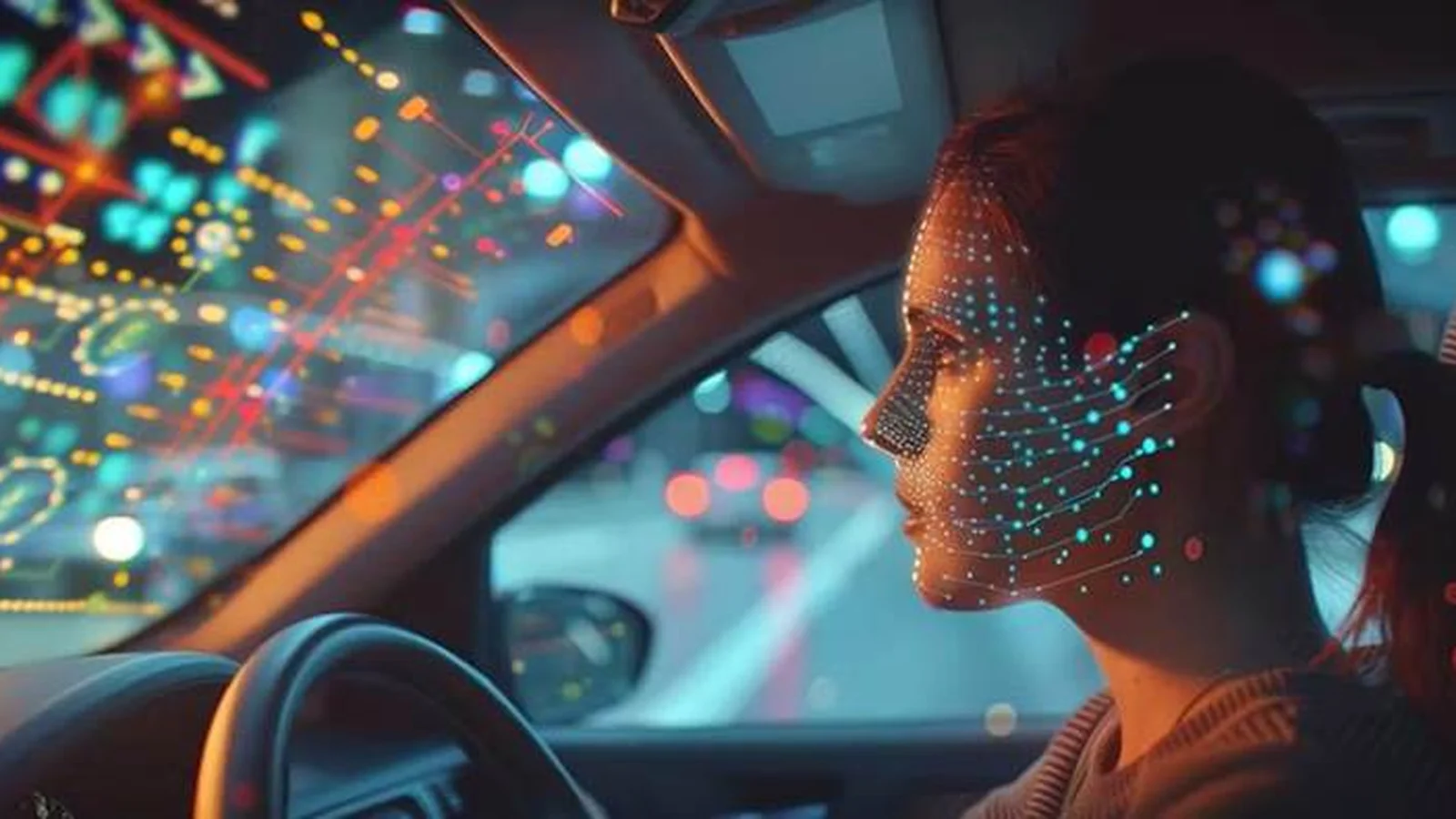
Most motion sickness technology reacts after the fact — a passenger already feels queasy, and the system responds. A more interesting engineering direction is trying to get ahead of that moment entirely: predicting, from sensor data alone, that a passenger is likely to become sick before symptoms actually appear, and adjusting the vehicle's behavior or the cabin experience preemptively. That shift — from detection to prediction — is where a lot of current research effort is going, and it's fundamentally a sensor fusion problem.
This post looks at the science behind why motion sickness happens, the sensing approaches being used to predict it, and what building a real-time comfort model actually requires.
Why Prediction Is Possible: The Sensory Conflict Model
Motion sickness isn't random — it follows a well-established mechanism called sensory conflict, or subjective vertical conflict (SVC) theory. The core idea: your inner ear (vestibular system) senses actual physical acceleration, while your visual system and internal expectations predict what motion should be happening based on what you can see and anticipate. When those two signals disagree — for example, your body feels the car turning while your eyes, buried in a phone screen, register no motion at all — the mismatch produces the symptoms we call motion sickness.
This matters enormously for autonomous vehicles specifically. Drivers rarely get carsick because active control gives them continuous, accurate predictions of upcoming vehicle movement — they know a turn is coming because they're the one initiating it. Passengers, and future "drivers" freed up to read or work in an automated vehicle, lose that predictive advantage entirely, which is a large part of why AV adoption research treats motion sickness as a real barrier to acceptance, not just an occasional nuisance.
Because the underlying mechanism is a predictable mismatch between sensed and expected motion, it becomes possible to build models that estimate motion sickness risk mathematically, rather than only detecting it after a passenger reports feeling unwell.
The Sensor Stack Behind a Prediction Model
Building a real-time motion sickness prediction model draws on several distinct sensing inputs, each capturing a different piece of the sensory-conflict picture.
Vehicle-level IMU data. A 6-degree-of-freedom inertial measurement unit — capturing specific forces and angular rates along three axes — is the foundational input, since it's what actually quantifies the acceleration and rotational motion the vehicle is producing moment to moment. This is largely the same IMU sensing infrastructure already covered in our posts on wearable and driver-cabin sensing, applied here to the vehicle body itself rather than a person.
Passenger head motion and gaze. Because sensory conflict theory centers on the mismatch between actual and visually-expected motion, several research prototypes go further than vehicle-level IMU data and directly measure a passenger's head acceleration, angular velocity, and even gaze direction — in one experimental setup, using a helmet-mounted IMU and camera to track exactly how a passenger's head moves and what they're looking at during a ride, in order to compute a "visual vertical" estimate reflecting what motion their visual system is actually registering.
Ambient and physiological context. Beyond pure motion data, real-time prediction devices have incorporated ambient temperature sensitivity and head-position tracking as inputs, recognizing that susceptibility to motion sickness isn't purely a function of vehicle dynamics — cabin environment and individual passenger state matter too.
Brain and neurophysiological signals. At the more advanced research end, some studies are fusing EEG (electrical brain activity) with fNIRS (a technique measuring brain oxygenation via near-infrared light) to build functional brain-network models of motion sickness — real-world testing across dozens of participants found significant, measurable differences in brain connectivity patterns between motion-sick and non-motion-sick states, with the best-performing models combining fNIRS data with high-frequency EEG signals specifically.
How the Fusion Actually Works: From Raw Sensors to a Sickness Score
Sensor fusion for motion sickness prediction generally follows a pattern familiar from other in-cabin sensing problems: combine multiple raw signal streams into a unified model that outputs a single, actionable estimate.
One practical research device illustrates this well — built around an embedded microcontroller and IMU with a live display, it captures the vehicle's acceleration profile and combines it with head-tilt and ambient-condition data to compute both an objective "motion dose" score and a corresponding subjective sickness score, calibrated against a large dataset of over 1,500 prior experimental trials. The objective/subjective scoring split is a meaningful design choice: it acknowledges that raw motion data alone (the objective dose) doesn't fully predict how sick a given passenger will actually feel (the subjective score), which varies by individual susceptibility.
More formal computational approaches extend classical SVC theory into full six-degree-of-freedom models, using synchronized IMU and camera data — sampled and aligned at matching frequencies — to estimate a continuously updating motion sickness index as the ride progresses, rather than a single static prediction made in advance.
What This Means for Cabin and Control System Design
A prediction model is only useful if it feeds into something that changes the passenger's actual experience. Current research points toward two main levers a fused comfort model can pull:
Preemptive path and trajectory planning. Rather than treating comfort as purely a cabin-experience feature, some research embeds motion sickness prediction directly into the vehicle's motion-planning and control algorithms — path planning that explicitly optimizes for a balance between motion comfort, safety, driving behavior, energy efficiency, and journey time, rather than treating comfort as an afterthought layered on top of an efficiency-optimized route.
Anticipatory sensory cues. A separate but complementary approach uses the prediction to trigger cues that help passengers anticipate movement before it happens — visual, haptic, or auditory signals timed just ahead of an actual maneuver, giving passengers back some of the predictive advantage that drivers have naturally. This is the same anticipation principle explored in seat-embedded haptic systems, just applied proactively based on a prediction rather than reactively after motion begins.
Engineering Considerations for Building This Kind of System
For teams working on in-cabin comfort sensing, a few practical implications stand out:
Latency matters as much as accuracy. A prediction that arrives after the maneuver has already started provides little benefit — the entire value of a predictive model over a reactive one depends on generating the sickness estimate with enough lead time to actually act on it, whether that's adjusting trajectory or firing an anticipatory cue.
Individual calibration is unavoidable. Since subjective susceptibility varies significantly between passengers even under identical objective motion conditions, a production system likely needs some form of per-passenger baseline or personalization, similar to the individual calibration challenges we've covered in driver-state sensing.
Sensor tier should match the product tier. A full EEG/fNIRS brain-network model is a meaningfully different engineering and cost proposition than an IMU-and-camera-based prediction device — most near-term production systems will realistically sit closer to the vehicle-motion-plus-head-tracking end of this spectrum rather than the neurophysiological end.
Prediction and mitigation need to be architected together. A sickness score is only valuable if it's wired into an actionable response — trajectory adjustment, haptic cueing, or cabin environment changes — meaning the prediction model and the mitigation system are really one integrated design problem, not two separate ones.
Conclusion
Motion sickness prediction is a genuinely tractable engineering problem precisely because the underlying mechanism — sensory conflict between actual and expected motion — is well understood and mathematically modelable. The sensor fusion challenge is less about any single exotic sensor and more about combining vehicle motion data, passenger head and gaze tracking, and increasingly ambient or physiological context into a model that's fast enough to act on before symptoms appear. As autonomous vehicles push more passengers into a purely passive role, systems that can predict discomfort ahead of time — and feed that prediction directly into trajectory planning or anticipatory cabin cues — are likely to become as central to AV comfort engineering as collision avoidance is to AV safety engineering.
At CoBuild Labs, this kind of predictive, multi-sensor comfort modeling draws on the same core sensor fusion and embedded systems expertise we bring to wearable and driver-state sensing — building models that act on a prediction, not just a detection — with AI and wearable motion-sickness sensing.
Building in-cabin comfort sensing? Talk to CoBuild Labs — continue with wearable motion-sickness detection, cabin physiological sensing, and sensor-fusion AI.