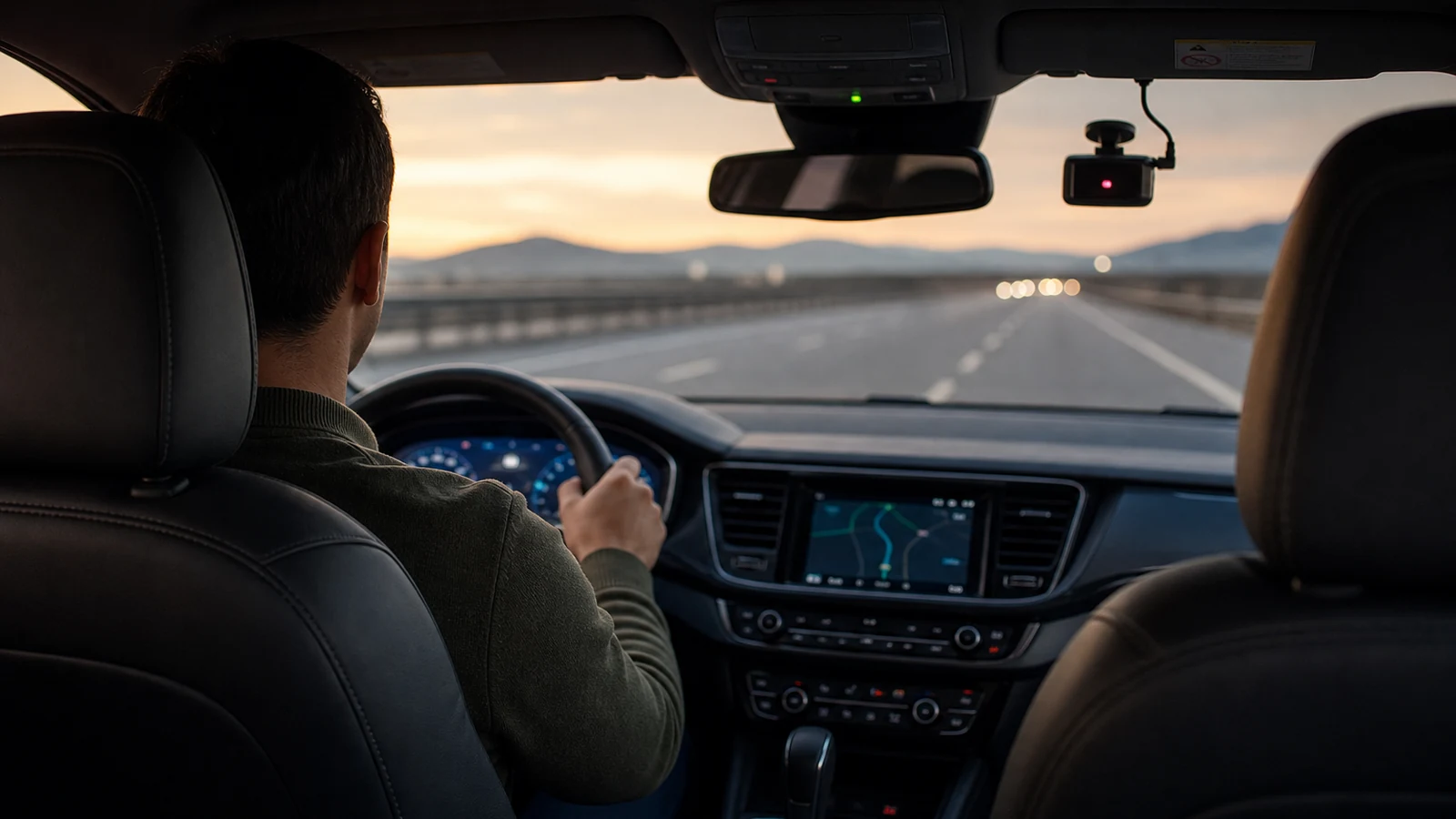
Every year, distracted, drowsy, and fatigued driving contributes to a staggering number of road accidents. For decades, car makers have tried to solve this with sensors that watch our eyes, steering, and heart rate. But what if your car didn't just watch you — what if it could understand how you're feeling and step in when you needed help?
That question sits at the heart of Human-Robot Interaction (HRI) in driver monitoring systems: moving from a passive dashboard light to an intelligent co-pilot that can interact, adapt, and — in a real emergency — safely intervene. This overview is informed by recent HRI research, including a University of Tennessee literature review (arXiv:2401.15762).
From passive monitoring to active partners
Traditional systems quietly track heart rate, eye movement, or steering patterns and flash a warning when something looks off. Researchers are increasingly asking what happens when these systems take a more active role — engaging in two-way conversation, adapting in real time, and taking meaningful action when needed. As vehicles move toward greater autonomy, the human–machine relationship on the road becomes more important, not less.
The sensors doing the heavy lifting
A modern driver monitoring stack typically fuses several modalities:
- Cameras and computer vision for fatigue, stress, and frustration cues
- Microphones and speech recognition for vocal stress indicators
- Physiological sensors (ECG, EEG, skin conductance) for arousal and fatigue — increasingly embedded directly into the steering wheel and seat rather than worn
- Eye-tracking for gaze, blink rate, and fixation
- Steering and lane-keeping sensors for subtle drifts
- Seat pressure and depth/LiDAR for posture and head position — even in poor lighting
Individually, each gives a partial picture. Combined, they enable a nuanced understanding of driver state — the same multi-sensor philosophy we discuss in biosensor selection for medical wearables.
Making sense of the data: where AI comes in
Collecting sensor data is only half the story. Machine learning models (SVMs, random forests, CNNs/RNNs) recognize behavioral patterns and flag warning signs. Regression models estimate cognitive load in real time; online learning adapts to an individual driver over time. Deep networks plus NLP can fuse face, voice, and physiology into a holistic emotional read.
Building that stack on-device or at the edge is exactly where AI integration and firmware engineering meet — especially when latency and privacy constraints rule out a cloud round-trip.
Personalization is the real goal
- Dynamic driver profiles that evolve with habits and responses
- Adaptive feedback that withholds non-urgent alerts under heavy cognitive load
- Customizable interaction styles — voice, haptic, visual
- Long-term learning across weeks, not just a single trip
- User-set thresholds for sensitivity and privacy
Personalization isn't just convenience — it's central to driver trust, which researchers consistently flag as essential for long-term acceptance.
What a robotic co-pilot could look like
Proactive interaction — gradual interventions for early drowsiness or distraction: alerts, conversation, music, nearby stop suggestions.
Active interaction — reserved for emergencies: steer to the shoulder, hazard lights, call for assistance when the driver is unresponsive.
Challenges still standing in the way
- Real-time emotion reading remains hard across individuals and contexts
- Interfaces must inform without becoming another distraction
- Trust and privacy take time to earn
- Multi-sensor fusion without lag is a serious engineering challenge
- Industry standards across vehicle platforms are still immature
Where this is headed
Promising directions include culturally aware emotion models, longer-term trust studies, standardized vehicle communication protocols, and stronger ethical frameworks for data and bias. The bigger picture: the car as a partner in safety — not just a machine you operate.
For teams building cabin sensing hardware, the same discipline applies as any wearable or MedTech product: validate early (Validate Before You Tool), and design electronics for real-world noise with electrical engineering. Talk to usif you're exploring a driver-monitoring prototype.