
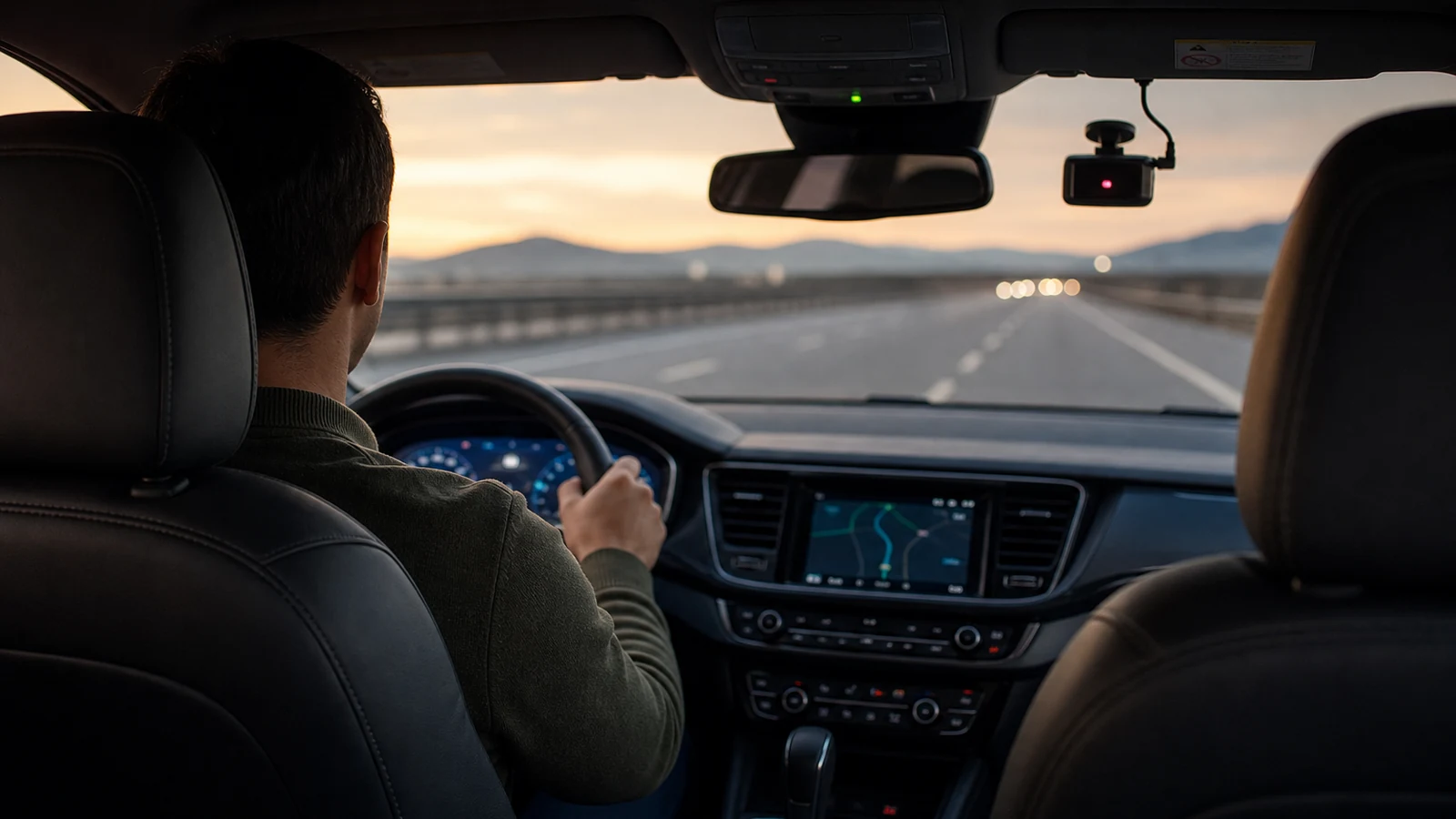
A driver monitoring system with excellent detection accuracy can still fail completely in the field — not because the sensing was wrong, but because the driver stopped trusting it. Drivers disable systems they find annoying. They habituate to alerts that fire too often. In some documented cases, they let their own drowsiness progress further than they otherwise would, because the alarm made them overconfident that a warning would come in time. None of these are sensing failures. They're trust failures, and they're just as capable of getting someone hurt as a missed detection.
This post looks at why raw accuracy is an incomplete measure of a driver monitoring system's real-world value, what the research says about how false alarms and misses erode trust differently, and what that means for how alerts actually need to be engineered.
Two Ways to Be Wrong, Two Different Costs
Every detection system makes two kinds of errors: false alarms (warning when nothing is actually wrong) and misses (failing to warn when something is). It's tempting to treat these as symmetric problems to minimize together, but research on trust in automated driving systems shows they degrade driver behavior in meaningfully different ways.
One recent simulated-driving study compared systems biased toward false alarms against systems biased toward misses, and found that drivers exposed to a miss-prone system showed higher perceived risk, lower trust, and were more likely to actively monitor and take over from the automation — compared to drivers exposed to a false-alarm-prone system. In other words, misses erode trust in the system's competence, while false alarms erode trust in its judgment — and both failure modes push drivers toward different, but equally undesirable, compensating behaviors.
A related study on pedestrian-crossing alert systems found that false alarms didn't just get ignored — they actively degraded driver behavior, producing excessive caution, alert fatigue, and anxiety, including at least one case where a driver braked hard for a pedestrian who wasn't there. Poor sensor calibration and difficult environmental conditions like fog, rain, or low light were identified as common root causes of these false alarms — which ties directly back to the sensing robustness challenges any DMS engineering team is already fighting.
- When Drivers Adapt to Warnings — In the Wrong Direction
Perhaps the most counterintuitive finding in the driver monitoring literature is that alerts can backfire even when drivers don't disable the system at all. A frequently cited study found that drivers exposed to drowsiness warnings over time began to over-trust the alarms — letting their own drowsiness progress further before taking a break than they otherwise would have, effectively outsourcing their own self-monitoring to a system they'd come to rely on too heavily, with researchers reporting that the alarms were ultimately disregarded.
This is a genuinely difficult design tension: a system needs to be trusted enough that drivers act on its warnings, but not so implicitly trusted that drivers stop attending to their own physical state and treat the system as a substitute for judgment rather than a supplement to it.
- Why Alert Fatigue Isn't Unique to Driving — But Is Especially Dangerous There
The pattern of high alert volume leading to overrides, delayed responses, and reduced trust is well documented far beyond automotive — in clinical monitoring settings, non-actionable alert rates frequently exceed 70% across physiological monitoring systems, and that volume alone is enough to drive clinicians toward ignoring or overriding alerts, sometimes at override rates exceeding 90% in related decision-support contexts.
The mechanism is the same in a vehicle, but the stakes are different: a driver who has learned to dismiss frequent false alerts as noise is exactly the driver who's most likely to also dismiss the one alert that's actually correct.
What Actually Reduces False Alarms Without Sacrificing Detection
The good news is that false-alarm reduction is an active, tractable engineering problem, not a fundamental trade-off that has to be accepted. A few approaches from recent research illustrate what's possible:
Adaptive, confidence-aware detection windows. One recent framework combining a lightweight neural architecture with an uncertainty-estimation layer reduced false alarm rates by over 35% relative to a fixed detection-window baseline, while sustaining real-time performance on automotive-grade embedded hardware — and critically, its highest-confidence predictions achieved over 95% accuracy, showing that confidence-aware systems can selectively suppress the alerts they're least sure about rather than firing indiscriminately.
Multimodal fusion, covered in our recent post on fusing vision, physiology, and vehicle behavior, directly reduces false-alarm risk as a side effect of improving robustness — a single degraded sensor stream is less likely to trigger a false alert when other independent streams can corroborate or override it.
Adjustable sensitivity calibrated to context. Steering-based detection is highly effective on highway driving but prone to false positives in urban environments full of legitimate steering inputs — meaning static, one-size-fits-all sensitivity settings are themselves a source of false alarms that context-aware thresholds can reduce.
Designing Alerts Drivers Actually Trust
Beyond reducing false alarm rates at the detection layer, alert presentation itself is a design problem with real research behind it:
Alert modality matters, not just alert accuracy. Multimodal alerts (combining sound and vibration, for instance) have been shown to be more effective than single-channel warnings — but every additional alert channel is also another opportunity to annoy a driver if poorly tuned, so modality choice needs to match the urgency and confidence of the underlying detection.
Progressive, tiered warnings outperform binary alerts. Escalating alert intensity based on the severity or confidence of detection — rather than firing the same alarm regardless of certainty — respects the driver's attention budget and reduces the habituation risk that comes with constant maximum-intensity alerts.
Individual calibration reduces false positives at the source. Establishing a driver's baseline behavior during known-alert periods, rather than applying population-level thresholds, cuts down on the false alarms that stem from normal individual variation being misread as a warning sign.
The system needs a coherent mental model the driver can learn. Alert behavior that's intuitive, consistent, and easily understood earns trust over time; alert behavior that feels arbitrary or unpredictable — firing under conditions the driver can't map to their own experience — erodes it, regardless of the underlying accuracy.
Conclusion
A driver monitoring system's real-world safety value isn't determined by its accuracy on a validation dataset — it's determined by whether drivers keep the system engaged, attend to its warnings, and don't quietly compensate for its behavior in ways that undermine the very safety benefit it was built to provide. Reducing false alarms through adaptive detection and multimodal fusion, and pairing that with alert designs that respect a driver's attention and build an accurate mental model over time, are what actually turn a technically accurate system into one that saves lives on the road rather than one that gets muted, ignored, or unplugged.
At CoBuild Labs, we treat this as inseparable from the sensing engineering itself — a DMS is only as good as the trust it earns — design it with multimodal fusion and on-device AI, not bolted-on alerts.
Working on DMS alert strategy? Talk to CoBuild Labs — pair this with multimodal fusion, 2026 DMS regulations, and on-device AI.