
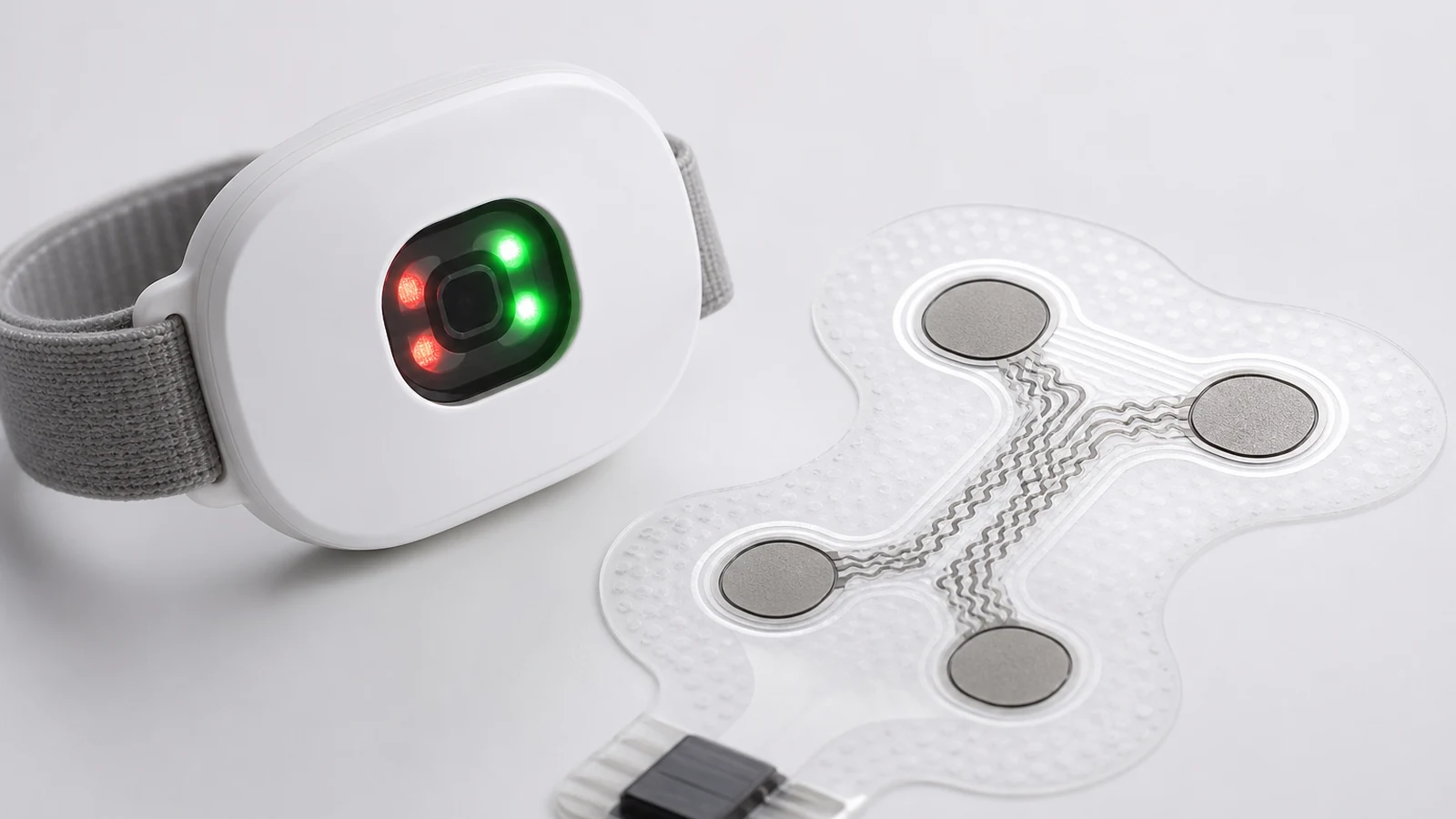
The line between "wellness gadget" and "medical device" isn't fixed — it moves based on what a company claims about its product, sometimes years after the hardware was already designed and shipped. That's exactly what happened to WHOOP in mid-2025, when the FDA alleged the company marketed its "Blood Pressure Insights" feature — describing daily blood pressure estimations and "medical grade" insights — without the required clearance. A few months later, in January 2026, the FDA issued sweeping new guidance that redrew where that line actually sits.
For hardware teams building consumer health and wellness products, this creates a genuinely tricky design problem: build a product that can launch quickly as a general wellness device today, without foreclosing the option to pursue medical-device claims later — without having to redesign the sensing, firmware, or data architecture from scratch when that day comes.
What "General Wellness" Actually Means Now
On January 6, 2026, the FDA finalized a revised version of its General Wellness Policy for Low Risk Devices, replacing the 2019 guidance and meaningfully expanding what qualifies as a non-device wellness product. The core policy is unchanged: the FDA exercises enforcement discretion — meaning it does not expect the product to go through standard medical device regulatory requirements — for products whose intended use is limited to general wellness and that present low risk to users.
What changed is how that applies to modern wearables. The updated guidance takes a broader view, explicitly stating that noninvasive wearables estimating physiological measures — heart rate, sleep quality, even blood pressure and blood glucose in some cases — can still qualify as general wellness products, provided they're genuinely intended for wellness use, pose minimal risk, and avoid disease-specific, diagnostic, or treatment-oriented claims.
The FDA added new worked examples to make this concrete, including a wrist-worn wearable that outputs biomarkers like sleep hours, pulse rate, and blood pressure using noninvasive technology for activity and recovery purposes, and a wearable providing blood glucose estimations via minimally invasive microneedle technology for tracking nutritional impact — both potentially qualifying as general wellness products depending on how they're positioned and marketed.
Where the Line Actually Gets Crossed
The determining factor isn't the sensor or the underlying measurement — it's intended use, which the FDA infers from claims, labeling, advertising, and how information is presented to the user. Two products with functionally identical hardware can land on opposite sides of the regulatory line based entirely on marketing language and interface design.
This is precisely what the WHOOP situation illustrates: a wellness-positioned product can drift into medical device territory through the specific language used to describe its outputs, even when the underlying feature could plausibly have stayed within wellness boundaries with different framing.
There's some nuance worth noting on the permissible side, too — general wellness products are allowed to prompt users to consult a healthcare professional when readings fall outside normal ranges, as long as the product avoids disease-specific, diagnostic, or treatment-oriented language in doing so. That's a real, if narrow, allowance for wellness products to gesture toward clinical relevance without crossing into regulated territory.
Why This Matters at the Hardware Design Stage
It would be easy to treat this as a marketing and legal problem, solved entirely with careful claims language after the product is built. That's a mistake. Several engineering decisions made early in a product's development directly determine how much freedom the company has to make medical claims later — or how expensive it will be to add them.
Sensor accuracy and validation data. A wellness product can ship with looser accuracy tolerances and no clinical validation study. A future medical claim for the same measurement will require clinical-grade validation against a reference standard — which is far cheaper to plan for at the AFE and sensor-selection stage than to retrofit onto hardware that was never designed with that accuracy ceiling in mind.
Data architecture and traceability. Medical-grade claims eventually require design controls, risk documentation, and audit trails that most consumer wellness products don't build in from day one. A data pipeline built with basic versioning and traceability in mind costs little extra upfront and saves a substantial rebuild later.
Firmware and cybersecurity posture. FDA cybersecurity requirements may not apply to general wellness products the way they do to cleared medical devices — but a connected product designed with weak security architecture from the start will need meaningful rework if a medical pathway is pursued later, since cybersecurity documentation is one of the fastest-growing areas of FDA scrutiny for connected devices.
Claims-to-hardware mapping. It's worth explicitly documenting, at the design stage, which hardware and firmware capabilities are "wellness-safe" today and which would require a predicate device search, clinical validation, or a 510(k)/De Novo pathway if the company later wants to make a stronger claim. That mapping should live in the product requirements document, not get reconstructed retroactively by a regulatory consultant.
The Dual-Compliance Design Pattern
A few concrete practices let a product ship fast as a wellness device while keeping a credible path to medical claims open — complementary to FDA clearance realities:
Design sensing hardware to the accuracy ceiling the future claim would require, even if the current claim doesn't need it — the AFE, sensor placement, and mechanical design are the hardest and most expensive things to change later, so it's worth over-specifying them relative to the initial wellness-only claim.
Separate "wellness" and "clinical" claims explicitly in firmware and UI, so that toggling on a more clinically framed feature set later doesn't require touching the core sensing pipeline — only the presentation layer and validation behind it.
Build data logging and traceability in from the start, even at wellness-tier simplicity, so the historical data needed to support a future clinical validation study already exists rather than needing to be collected from scratch after the decision is made.
Treat cybersecurity architecture as though clearance were already the goal. It costs comparatively little to build in now and becomes one of the more expensive things to retrofit into a shipped, connected product.
Document the regulatory rationale for current wellness claims as the product is designed, not after a warning letter arrives — a clear, contemporaneous record of why specific claims and language were chosen is itself a risk-reduction asset.
Conclusion
The 2026 general wellness guidance gives hardware teams genuinely more room to ship physiological-sensing wearables without a full medical device pathway — but it also raises the stakes on getting the claims-to-hardware relationship right, as the WHOOP situation shows. The teams best positioned to take advantage of that room are the ones that treat "we might pursue a medical claim later" as a real design input from day one — not a decision to revisit only once the wellness product has already found a market and the pressure to add clinical credibility shows up.
At CoBuild Labs, we build wearable sensing systems with this dual-compliance path in mind from the outset — aligning sensor and AFE selection with both wellness and clinical paths — see FDA clearance and certification.
Shipping wellness now with a medical option later? Talk to CoBuild Labs — align hardware with certification, biosensor selection, and general product certification.