Every January, CES fills a few million square feet with devices that look finished — sleek enclosures, working demos, confident booth pitches. A year later, most of them are gone. Not because the underlying idea was bad, but because the gap between "working prototype" and "shippable product at volume" is where most hardware concepts actually die.
Roughly 97% of hardware startups fail, and only about a quarter of them ever make it to a second round of funding. The failures are rarely about the core idea — they're almost always about what happens in the space between a proof of concept and a certifiable, manufacturable, field-reliable product. This post breaks down what that space actually contains, and why it consistently catches teams off guard.
The Prototype Is the Easy Part
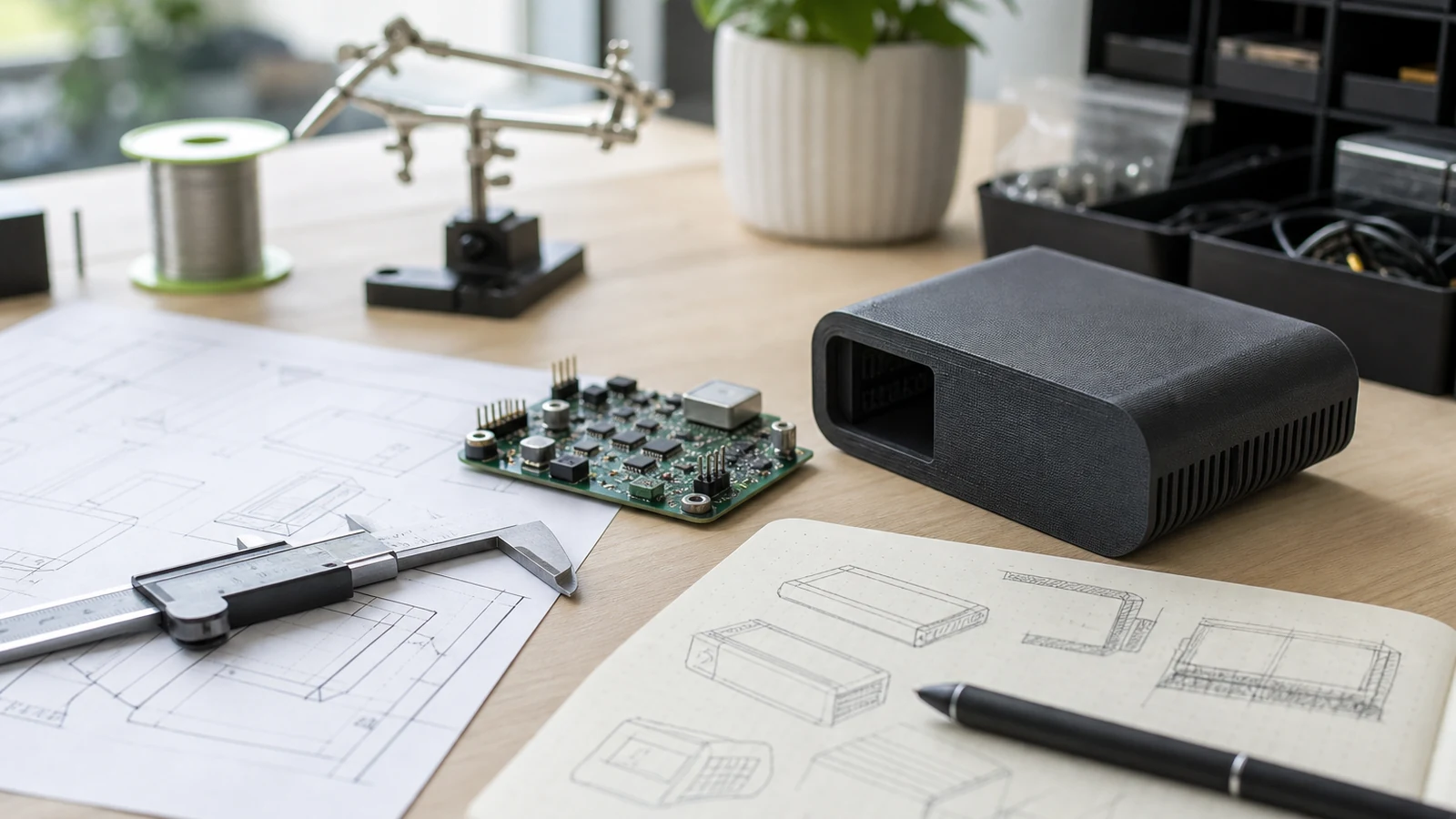
A CES demo unit, or an early proof-of-concept, is usually built to answer one question: does this work at all? At that stage, an off-the-shelf enclosure, a hand-soldered board, or a 3D-printed housing is completely reasonable — the goal is proving the concept, not proving it can be built a hundred thousand times.
That's exactly what makes the demo stage deceptive. A device that works reliably as one hand-built unit on a booth floor, under controlled lighting and temperature, with an engineer standing nearby to nurse it through the day, tells you almost nothing about whether the same design can be manufactured consistently, pass certification, and survive real-world conditions for years.
- Where Concepts Actually Break: The Journey to Volume
- 1. Design-for-Manufacturing (DFM) rework
A proof-of-concept enclosure and sensor layout is typically optimized for "does it fit and work," not for injection molding, pick-and-place assembly, or consistent tolerances at scale. Moving from a prototype to a manufacturable design often means reworking mechanical tolerances, connector choices, and assembly sequencing — work that's frequently underestimated in both cost and time, and that can quietly reshape the product if it's addressed too late.
- 2. Certification and compliance
Any connected consumer device needs to clear regulatory hurdles — FCC/CE for RF emissions, safety certifications, and increasingly, cybersecurity requirements for anything transmitting data. These aren't formalities: they can force real design changes (shielding, antenna placement, firmware-level security controls) if they're treated as a final checkbox instead of a design constraint from the start.
- 3. Field conditions versus lab conditions
A prototype that performs perfectly on an engineer's bench doesn't automatically survive temperature extremes, humidity, vibration during shipping, electrical noise from nearby devices, or the far less careful handling of an average consumer. Teams that skip accelerated life testing and environmental stress testing routinely discover these failure modes only after the product has shipped — the most expensive place to find them.
- 4. Supply chain and component lifecycle risk
A component that was easy to source during prototyping can become scarce, discontinued, or price-volatile by the time a design is ready for volume — and in 2026 specifically, rising memory costs and general supply chain volatility have become one of the most cited risk factors for hardware programs, in some analyses now outweighing tariffs as the primary concern. A design locked around a single-source part with no qualified second source is a production line waiting to stall.
- 5. Feature creep after the concept is "working"
It's tempting to keep adding capability once a demo is impressing people — but every added feature after the concept stage adds cost, complexity, and new failure surfaces to a design that hasn't been hardened yet. A disciplined, frozen minimum viable feature set is one of the most consistently cited factors separating teams that ship from teams that stall out chasing an ever-expanding spec.
- 6. Underestimating true time and cost to volume
Lengthy, poorly bounded development timelines and running out of funding before reaching a sellable product are two of the most commonly cited causes of hardware program failure. The full path — tooling, certification, test development, supplier qualification, pilot runs — has more dependencies and longer lead times than most product roadmaps initially budget for.
What Separates the Devices That Actually Ship
The hardware teams that consistently make it from concept to volume tend to share a few habits:
They treat DFM as a day-one constraint, not a phase-two cleanup task. Manufacturability considerations shape early mechanical and component decisions, rather than being reverse-engineered into a finished design.
They identify certification requirements before finalizing the architecture. RF design, safety, and cybersecurity requirements are scoped early enough to influence antenna placement, shielding, and firmware architecture — not discovered during a failed test.
They test for the real world, not the demo floor. Environmental stress testing, accelerated life testing, and realistic handling scenarios happen well before tooling is committed.
They qualify a second source for critical components before a single-supplier dependency becomes a production-halting risk.
They freeze the feature set deliberately, pushing everything else to a clearly labeled v2 — a focused product that actually ships beats an ambitious one that never does.
Conclusion
The gap between a CES demo and a shipping product isn't really a technology gap — most of the underlying sensing, compute, and connectivity technology on a convincing demo floor already works. The gap is an engineering-discipline gap: DFM, certification, environmental validation, supply chain resilience, and feature discipline, applied consistently from the earliest design decisions rather than bolted on once a prototype has already impressed someone. The teams that internalize that distinction early are the ones whose products are still around a year after the show floor lights go dark.
At CoBuild Labs, we treat the prototype-to-production transition as the core engineering problem it actually is — building manufacturability, certification readiness, and field reliability into the design early — the same mindset as Validate Before You Tool.
Stuck between a demo and a shippable product? Talk to CoBuild Labs about prototyping, manufacturing support, and validating before you tool — plus the cost mistakes that quietly kill margins.